
In most organizations, ERP platforms sit at the core; but when the integration surface around them is left uncontrolled, that surface becomes the most fragile spot. As connections to systems like banks, e-invoicing, logistics, HR, dealer portals, or data warehouses multiply, exposing the ERP core directly to the outside turns into a costly mistake — both for security and for operability. For that reason, integration DMZ design should not be treated only as a network security topic; it belongs to enterprise architecture discipline.
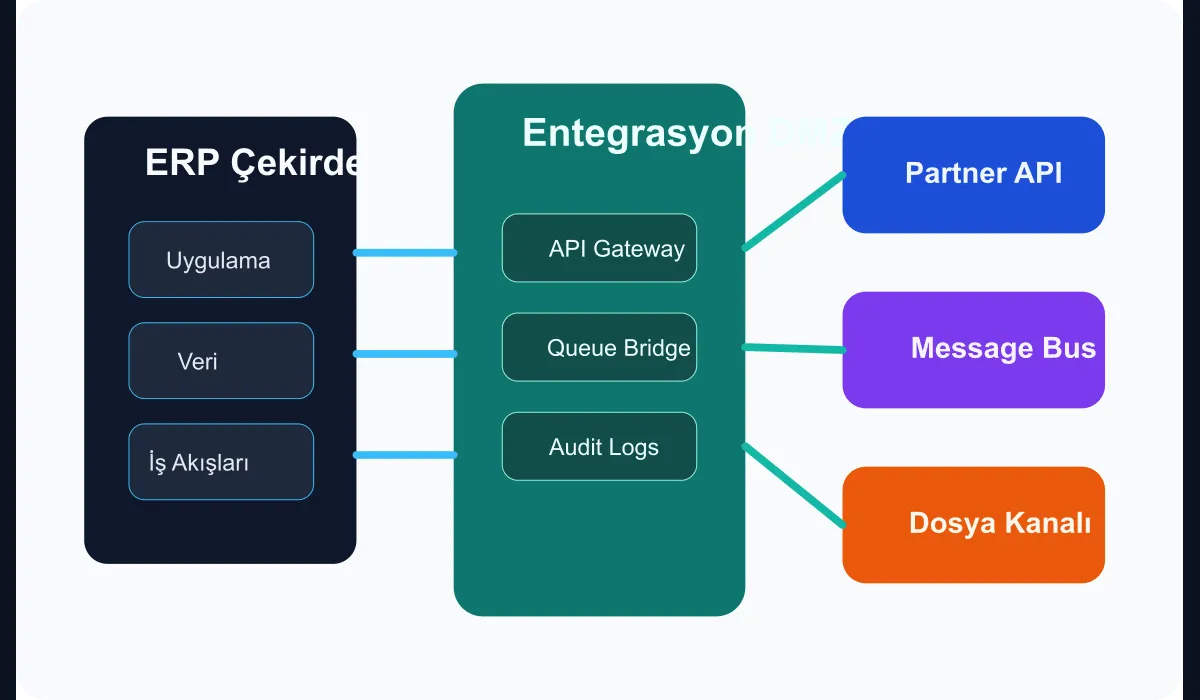
What does an integration DMZ actually solve?
The most common mistake is having ERP application servers accept user traffic and integration calls from the same network plane. This model looks fast in the short term; but a few months later, it becomes unclear which service speaks on which port, with which identity it authenticates, and which flow is genuinely business-critical.
The integration DMZ approach organizes this mess through the following separations:
- It establishes a dedicated security and protocol layer between the ERP core and the outside world.
- It classifies file, API, message queue, and batch flows.
- It centralizes controls such as identity, certificates, logging, and rate limiting.
- It narrows the blast radius when something breaks.
Thanks to this layer, the question “who is reaching the ERP?” becomes technically traceable.
Which components should live in this zone?
Moving everything into the DMZ is not the right move. But the following services are usually well suited to this zone:
- API gateway or reverse proxy layer
- Messaging bridges and integration agents
- Secure file transfer services
- Connection termination components for partner links
- Integration logging and audit services
The core principle here is this: business rules remain in the ERP itself or in the controlled application services around it; the external touch surface, however, is managed inside a separate protective band.
Why aren’t firewall rules alone enough?
In enterprise environments, the phrase “we opened the required ports” is often mistaken for architectural design. Yet integration risk doesn’t form purely at the port level. The real risk accumulates in areas like these:
- The same service account being shared by many partners
- A certificate renewal process advancing manually
- Failed requests not being monitored centrally
- Production and test integrations becoming entangled
- Not knowing who triggered file-based flows
In integration DMZ design, the network rule is only the first filter. Identity, observability, and lifecycle discipline matter just as much.
Why is classifying traffic from the start so critical?
Around an ERP, you typically see four core integration types:
- Synchronous API calls
- Asynchronous queue or event streams
- Scheduled batch data transfers
- File-based communication with external parties
Forcing these four flows into the same operational model creates inefficiency. For example, a dealer portal needs low-latency APIs, while financial reconciliation may demand stronger file integrity and auditability. Integration DMZ design pays off when it can apply different security and monitoring policies to different flow types.
Which signals should be collected on the operations side?
If this zone is left blind, problems only surface to the ERP team as “integration is broken.” Instead, the following signals should be standard:
- Success rate by source and target system
- Queue backlog and retry counts
- Certificate expiry dates
- Error distribution by partner or channel
- Latency thresholds and capacity limits
This approach helps you separate, within minutes during an incident, whether the ERP core is at fault or the external connectivity layer is the weak point.
Practical design principles to start with
- Don’t expose the ERP core directly to the internet or partner networks.
- Split external integrations across separate entry points by protocol type.
- Define a separate identity or certificate lifecycle for each partner.
- Wire all integration calls into a central logging and alerting system.
- Separate test and production flows at the network, identity, and observability layers.
Conclusion
Integration DMZ design in ERP infrastructures isn’t just placing a few servers in front of a firewall. Done right, it isolates the core business system from outside dependencies; it improves auditability and prevents the architecture from fragmenting as the partner ecosystem grows. In enterprise technology architecture, sustainability often begins right here: being able to protect a critical system while still managing integrations without a stop.