
In enterprise ERP modernization projects, one of the costliest mistakes is wiring every new analytics, integration, or microservice need straight into the ERP database. That model looks quick at first; over time, reporting queries disrupt production load, integration teams become dependent on each other’s data models, and ERP upgrades turn into wide blast zones. A data replication layer eases this pressure by inserting a controlled buffer between the ERP core and the consumer systems.
What does the replication layer solve?
The fundamental aim is to make data consumption scalable while protecting the operational core. A well-designed layer delivers the following:
- It reduces direct read pressure on the ERP database
- It manages integrations through shared data contracts
- It separates analytics, search, and reporting workloads
- It shrinks the blast zone; not every consumer touches the core system
This approach pays off especially in setups with multiple countries, business units, or integration partners.
What to consider when choosing the replication style?
The same solution doesn’t fit every scenario. Three models are commonly seen:
1. Bulk copy
This is the hourly or daily snapshot approach. It suits financial close, historical reporting, or low-frequency integrations. Simple, but it can’t meet real-time expectations.
2. CDC-based streaming
With Change Data Capture, table changes are carried into an event stream. This is strong for near real-time integration, data lake feeding, and event-driven architectures. On the other hand, schema evolution and ordering have to be handled with more care.
3. Domain-driven publishing
Instead of raw table changes, events with business meaning get published. This is the cleanest model; but producing it on the ERP side isn’t always easy.
In enterprise practice a hybrid model is usually needed: critical domain events come from the business layer, while broad data changes are carried via CDC.
Reference architecture
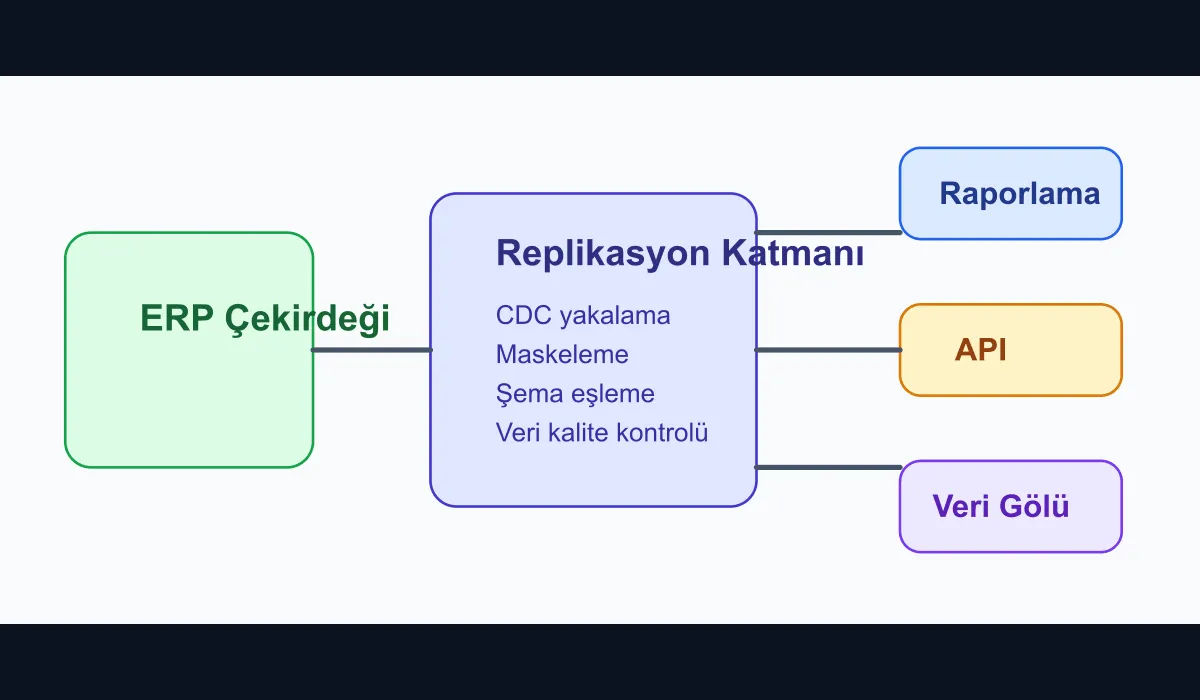
A model that works reliably in practice is built from these blocks:
- The ERP source system
- The replication or CDC capture layer
- The schema normalization and masking step
- Data services or topics that branch by consumer
- Dashboards for monitoring, latency, and data consistency
The key decision here is whether the replication layer will be a “passive copy” or a “managed data product layer.” The second approach asks for more discipline up front but considerably reduces integration chaos over time.
Security and authorization model
ERP data often contains personnel, finance, and procurement information. So the replication layer should not be lighter on security — sometimes it must be as tight as the core system.
- Sensitive columns should be split off via masking or tokenization
- Per-consumer access profiles should be defined
- It should be visible who reads which data product
- For copies moved into test environments, data anonymization should be mandatory
In particular, the request from analytics teams for “raw table access” looks easy in the short term; in the long term, it scatters governance.
Operational risks
Replication projects usually fail not technically but because of unclear ownership. The following questions should be answered up front:
- What is the latency budget?
- When a faulty record is reprocessed, how will the business impact be handled?
- Who will announce schema changes?
- How will source-system maintenance windows propagate to consumers?
Without these answers, the system may stand technically, but it loses trust in enterprise use.
When is it especially valuable?
A data replication layer delivers high return in scenarios like these:
- When the ERP feeds many adjacent systems
- When reporting queries impact production performance
- When modern apps and a legacy core have to live side by side
- When a multi-cloud or hybrid data consumption pattern has formed
The aim here isn’t to replace the ERP immediately, but to architecturally cool down the integration pressure surrounding it.
Conclusion
ERP modernization doesn’t always mean rewriting the core system. For most organizations, the real lever is to build a secure, observable, and controlled data replication layer around the ERP. That way, while modern services and analytics needs grow, the core system is strained less; upgrade, security, and performance decisions become more manageable.