
One of the toughest problems in ERP infrastructures is that the core transactional flow remains coupled to the speed and quality of surrounding systems. Finance, logistics, reporting, and third-party services react to the same business event at very different tempos. A message queue isolation corridor separates the ERP core from integration noise, improving both resilience and the capacity to change.
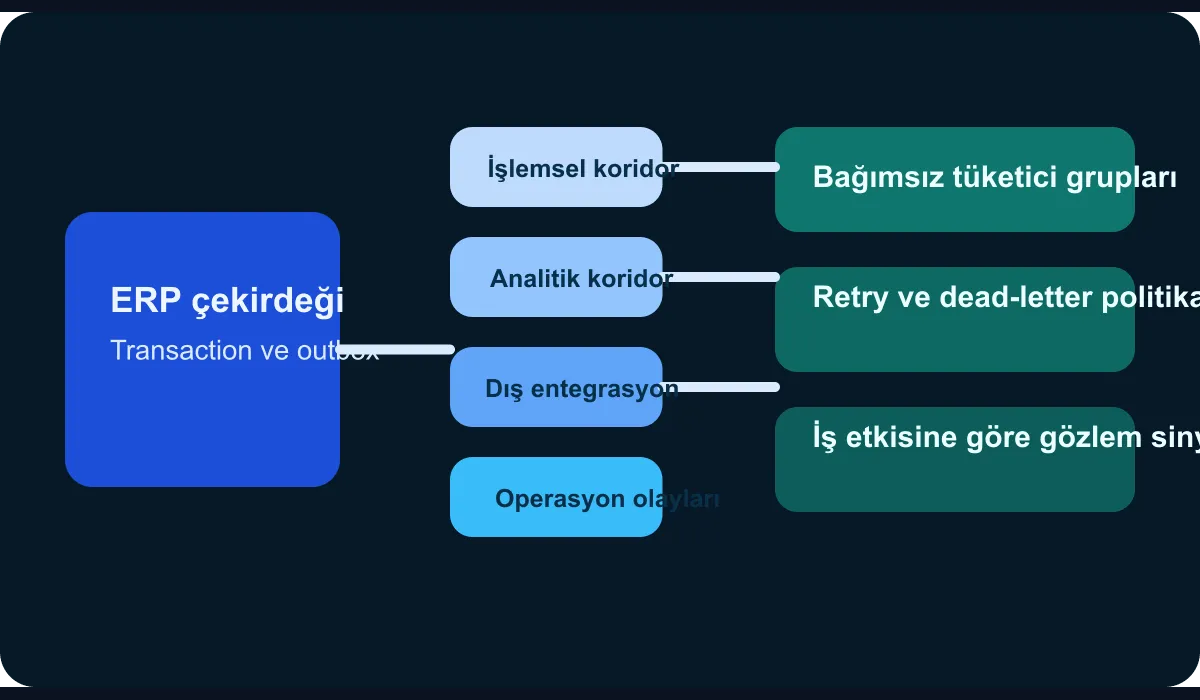
What does an isolation corridor solve?
In classic ERP integrations, when an order, invoice, or stock movement is created, multiple synchronous calls are made to external targets within the same transaction. This design seems clean at first; but when one target system slows down or fails, the core ERP flow is affected too. As a result, the business transaction and the integration delivery end up trapped in the same failure domain.
The isolation-corridor approach loosens this coupling as follows:
- The ERP core completes the work and produces a durable event record.
- The message queue layer decouples delivery from time.
- Consumer groups are separated by business priority.
- A failed integration produces back-pressure on its own; it does not lock the core.
In this way, the failure domain shrinks and system behavior becomes more readable.
The main principle in corridor design: not one queue, but controlled segregation
Many organizations interpret the move to an asynchronous architecture as throwing every event onto a single message backbone. Yet good design is less about adding a queue and more about drawing the right boundaries. ERP events do not share the same importance, the same delivery time, or the same data sensitivity.
In practice, this distinction creates high value:
- Transactional corridor: Latency-sensitive flows with a limited consumer set
- Analytical corridor: High-volume flows for data replication and reporting
- External integration corridor: Resilient deliveries headed for partners or legacy systems
- Operations corridor: Audit, notification, and observability events
This layering prevents every fault from impacting everything.
The boundary between the ERP core and the event record
For the isolation corridor to be reliable, a clear delivery model is needed between the core database transaction and the event record it produces. One of the most commonly used patterns is the outbox approach. When the transaction succeeds, the event is also persisted durably; a separate transporter then forwards that record to the queue system.
The important question here is: when is the event considered “processed”? The answer should not be “after the integration target receives it successfully,” but “after the ERP core writes the event record consistently.” Otherwise, an issue with an external system would distort the core’s definition of success.
How should consumer isolation be set up?
The success of the isolation corridor does not depend solely on the choice of broker. The real difference is determined by how cleanly you separate the failure domains of your consumers. On the ERP side in particular, these questions matter:
- Are stock synchronization and BI workloads in the same consumer group?
- When an external partner integration fails, does the retry storm reach the core?
- Are events landing in the dead-letter queue tagged with their business criticality?
- Is the same business event shared with different data redaction levels?
Without making these distinctions, even modern queue technology leaves the operational behavior in an outdated state.
A queue architecture goes blind without observability
Message queues often hide the system’s health. Transactions appear successful while queue lag silently grows. For this reason, the corridor design should track signals close to business impact, not only throughput:
- Queue lag
- Consumer failure rate
- Dead-letter accumulation
- Retry intensity
- Delivery time per event type
If these metrics are not bound to the service level, teams fall into the “the broker is up” delusion.
What should the migration strategy look like?
In large ERP infrastructures, moving every integration to an async corridor at once is risky. The right migration starts with the flows where coupling is strongest yet business impact is most controllable. The order I prefer is:
- Separate the audit and notification flows.
- Move the reporting and data-replication load away from the core.
- Shift external partner integrations onto separate retry policies.
- Tackle latency-sensitive transactions last.
This approach demonstrates the architectural gain early and progresses without shaking the trust placed in the core system.
Conclusion
A message queue isolation corridor in ERP infrastructures is not just integration modernization; it is an investment in business continuity. When the core ERP flow is separated from delivery problems, the failure domain shrinks and changing how surrounding systems integrate becomes easier. In enterprise architecture, the real value lies not in producing more messages, but in deliberately choosing which load is kept behind which boundary.