
When ERP integrations are fragile, the trouble usually starts not with the first failure but with the second attempt. Calls that repeat because of network outages, remote-system timeouts, or queue accumulation can lead to an order being opened twice, an invoice being generated repeatedly, or a stock reconciliation being broken. For this reason, the retry mechanism is not just resilience plumbing; it is data-correctness architecture.
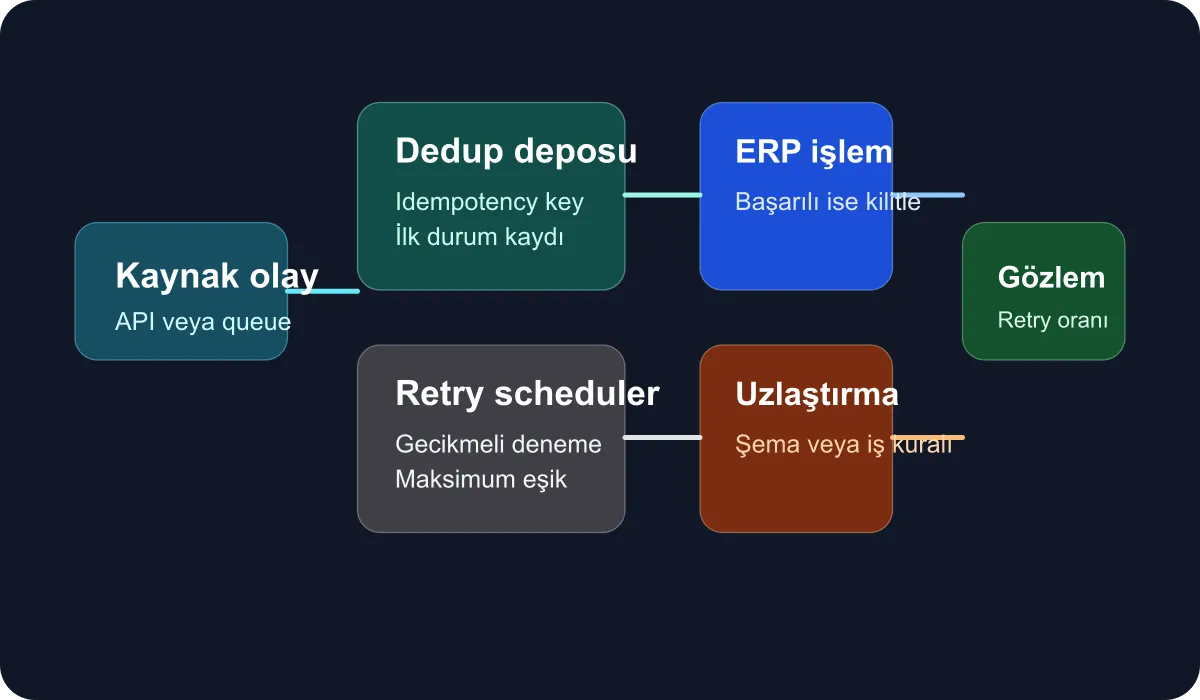
Why is classic retry logic not enough in the ERP world?
Many applications implement retry simply as “if it failed, try again.” Yet ERP systems are typically environments that hold state, produce side effects, and tightly audit transaction history. If the call reached the target but no response returned, the client may see failure while the record has already been created on the back end.
For this reason, the decision to retry should not be only a reaction to a network error; it should be considered together with the operation’s business key, the type of side effect, and the reconciliation capability.
What does a retry corridor mean?
I think of the retry corridor as running retries not in scattered application code but in a shared safety zone. This corridor typically takes on these responsibilities:
- Generation and storage of an idempotency key
- Tracking the state of the first attempt
- A delayed retry policy
- Poison-message handling
- A manual reconciliation queue
Thanks to this structure, the same integration behavior is not rewritten differently in different teams. In enterprise architecture, standardization produces value precisely here.
How should the idempotency key be chosen?
The most common mistake is to limit the idempotency key to the technical request id. The better approach is to use composite keys that carry business meaning. For example:
- Order number + transaction type
- Invoice number + version
- Source system event id + target record type
In this way, a network retry is distinguished from a genuinely new business event. Otherwise the system looks technically resilient while business data is silently corrupted.
Why is observability at the heart of the design?
Retry behavior that cannot be seen does not inspire trust. The corridor should produce these signals:
- The number of pending retries
- The records that have hit the maximum attempt threshold
- The repeat ratio per transaction type
- The percentage of work that lands in the reconciliation queue
These metrics are a mirror not only for the operations team but also for the health of the integration architecture. Especially during month-end ERP load peaks, you can read from this surface which connections systematically break.
When should automatic retry not happen?
Not every error is transient. The cases below are usually poor candidates for automatic retry:
- A schema or required-field error
- An authorization or certificate problem
- A business rule violation
- A version mismatch
In such cases, aggressive retry only fills the queue and hides the real problem. The real maturity of the corridor lies in knowing when to stop, just as much as when to retry.
An enterprise implementation model
In practice, this layered model works well:
- Idempotency key validation at the API or message entry
- Recording the first attempt in a state store
- A retry scheduler with delayed attempts
- A dead-letter or reconciliation queue
- A dashboard and incident-alarm surface
This flow lifts ERP integrations beyond “is it working?” to “is it controlled even when it breaks again?”
Conclusion
An idempotent retry corridor in ERP integrations brings resilience and data integrity into the same design. When you move retry out of the scattered reflexes inside applications and onto a shared architectural surface, errors are hidden less, operations recover faster, and trust in enterprise data rises noticeably.