
ERP systems are among the most sensitive points of the enterprise backbone, yet workflows in modern organizations no longer live within a single region. Finance might sit in Europe, supply chain in the Middle East, and the analytics platform in another cloud region. In this situation, funneling all integration traffic through one centralized layer looks easy in the short term, but over time it generates both data sovereignty pressure and operational latency. The regional integration cells approach is valuable precisely for relieving that congestion.
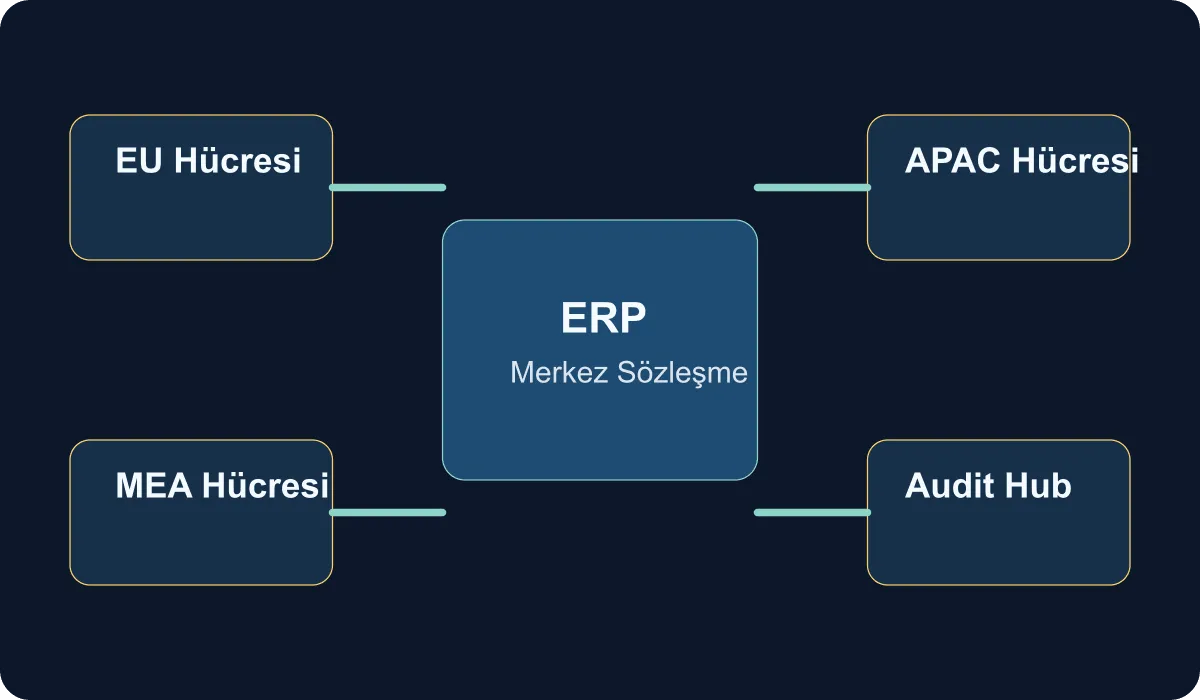
What does an integration cell actually solve?
The goal is not to clone the ERP. The cell approach is about building an integration envelope around the ERP core that operates according to local needs but communicates with the core through contracts. This envelope typically contains the following components:
- Regional API adapters
- A local messaging or event buffer layer
- Data masking and policy controls
- Region-specific observability and audit streams
This way each region can manage its own latency and regulatory needs while the core ERP avoids uncontrolled expansion.
Why might a centralized integration layer fall short?
Because, over time, a single layer ends up having to know everything:
- Regional data retention rules
- Protocol differences for local business partners
- Latency-sensitive workflows
- Translation, format, and idempotency details
As that density grows, even the smallest change turns into a release risk that touches the entire world. Regional cells, by contrast, distribute integration responsibility with a smaller blast radius.
What principles should the cell approach rest on?
I see four principles as critical here:
- The core must remain the single source of truth
- Regional cells should carry integration ownership, not data ownership
- Contracts must be versioned and measurable
- Each cell should be treated as an independent failure domain
Without these principles, the cell approach can quickly devolve into a fragmented copy architecture.
Why is it strong from a data sovereignty perspective?
For many organizations, the hardest territory is that not every piece of data can move into every region. Regional cells make the following distinctions much clearer:
- Which data fields can be processed locally?
- Which records get summarized and returned to the center?
- Which events are forwarded only as metadata?
- Which audit trail stays within the region?
This model turns data movement from a crude copy problem into an architectural decision governed by explicit contracts.
What is the operational payoff?
The most visible benefit is a smaller failure domain. For example, when a supply partner flow in the Middle East region breaks, the European finance integration does not have to be hit at the same time. Cells scale separately, raise separate alarms, and have separate rollback plans. That makes changes around the ERP much safer.
Observability also becomes more meaningful. Instead of generic integration logs flowing through one central place, each cell’s own SLO, retry metric, and delivery queue become readable on their own.
Which risks should not be forgotten?
The cell approach does not solve every problem. The following risks need to be managed openly:
- Drift between regional contract versions
- Weakening of shared identity and secrets management
- Governance breaking down because of excessive local customization
- Cross-region event correlation becoming harder
For this reason, cells should not be free zones but operational areas bounded by central principles.
Conclusion
Regional integration cells in ERP infrastructures break the integration load of single-hub global enterprises into more manageable pieces. When data sovereignty, latency, and operational resilience are addressed within the same frame, this approach delivers serious value, especially in multi-region setups. Real success lies not in giving every region the same technology, but in meeting local requirements within controlled cells without breaking the core ERP.