
When ERP modernization comes up, organizations often focus on application renewal, the move to cloud, or the choice of integration platform. Yet the actual fragility usually hides in the integration layer that has accumulated around the ERP. Sales, finance, warehouse, human resources, and reporting systems connect to the same core in different languages over the years. Once modernization starts, the issue is not the code itself but the surfacing of contract-less dependencies.
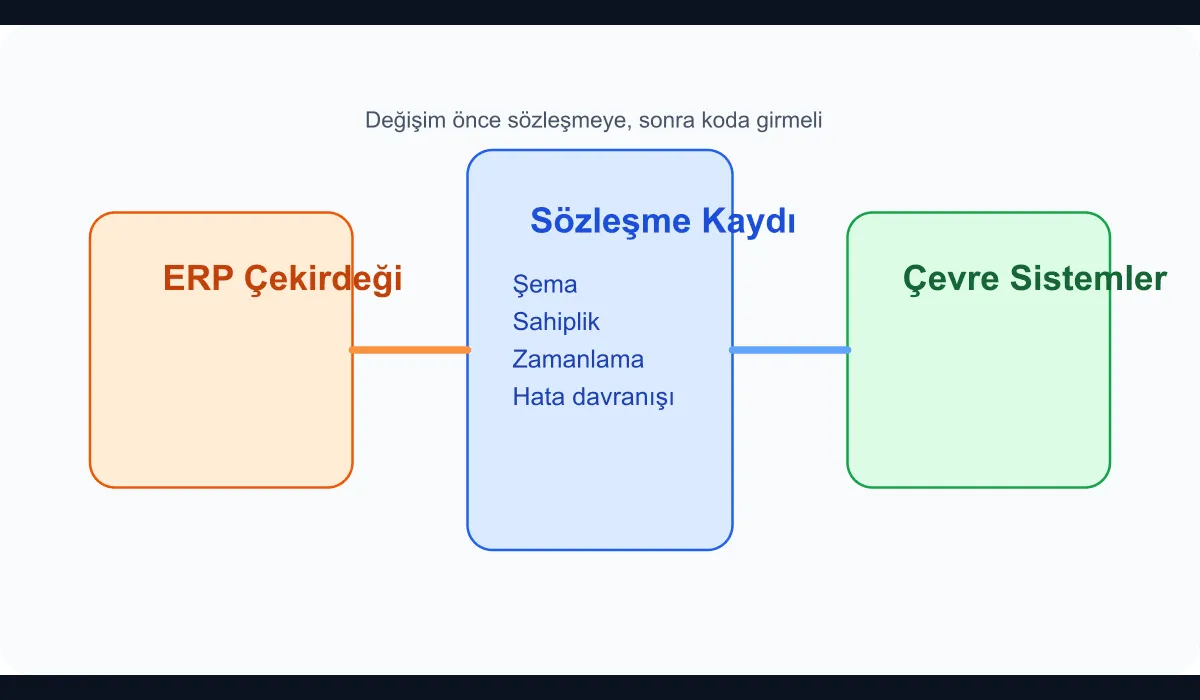
Why is the integration contract a central topic?
In enterprise structures, the ERP system is not just an application; it is the system of record for the business, from accounting entries to supply chain data. So every system that connects to the ERP, while technically an API consumer, is a business-critical dependency.
The problem is that in many organizations, these dependencies do not live through documented interfaces but through implicit expectations:
- A field name is assumed never to change.
- Latency tolerance is never written down.
- Because the batch window has stayed the same for years, it is accepted as a natural rule.
- It is unclear who steps in when something fails.
Integration contract governance turns these implicit behaviors into explicit operating rules.
A contract is not just a schema
Many teams hear “contract” and think of JSON schema, WSDL, or a list of table columns. But around the ERP, the actual contract is broader. The framework I use in practice consists of five parts:
- Data shape and required fields
- Timing expectation
- Error and retry behavior
- Ownership and change approval
- Backward compatibility boundary
When these parts are not written down, an integration may run technically but cannot be governed at enterprise scale.
Which risk grows during modernization?
The most common mistake during ERP modernization is wiring old integrations to temporary adapters with the thought “we’ll clean it up later.” That temporary layer often becomes permanent. As a result, the organization produces a new tangle around the modern ERP, running by old rules.
To prevent this, the following principle works: every new or migrated integration that connects to the ERP core should first enter the contract registry; only then descend to the code level. Modernization without a contract inventory only reproduces technological debt in a different form.
How should the governance model be set up?
Neither extreme centralization nor full freedom works here. The model I recommend makes this distinction:
- Domain teams are responsible for the business meaning of the contract.
- The platform or integration team provides transport standards and observability.
- The ERP team manages breaking points on the core system and the compatibility calendar.
Thanks to this role separation, everyone looks at the same place but does not do the same job. In particular, batch integrations, file-based transfers, and event streams can be governed under the same governance umbrella with different rules.
Which metrics actually work?
Integration contract governance is not measured by “document count.” More meaningful signals are:
- Share of integrations with a contract registry
- Share of integrations with a defined owner
- Number of backward-incompatible changes
- Share of contract violations among ERP-originated incidents
- Time from change announcement to going live
These metrics clearly show whether the organization is governing its integration layer or merely keeping it alive.
This is where the technical decision and enterprise communication meet
Integrations around the ERP look technical; but when they break, the impact area crosses the technical boundary. Therefore, integration contract governance is also an enterprise communication model. Who, which change, how far in advance, and through which channel — these questions must be part of the architectural decision.
Especially in large enterprises, an unannounced small field change sometimes breaks the data warehouse, the financial report, and field operations all at once. The problem is often less the system and more the coordination.
Conclusion
In ERP modernization, integration contract governance is not about putting bureaucracy between old systems and new platforms. The real goal is to make enterprise dependencies visible and to accelerate change in a controlled way. Renewing the core application matters; but modernization done without defining which rules its surrounding integrations will live by only produces a new fragility that simply looks more modern.