
In enterprise cloud architectures, the most expensive problems often emerge not from the choice of compute, network, or storage; they emerge from ambiguity around where identity starts and at which boundary it ends. If multiple accounts, environments, and teams share the same cloud backbone and the identity model is not clear, every new service produces not only technical risk but also governance risk. Shared identity boundary design aims to solve this complexity not with a single IAM document but with explicit responsibility layers.
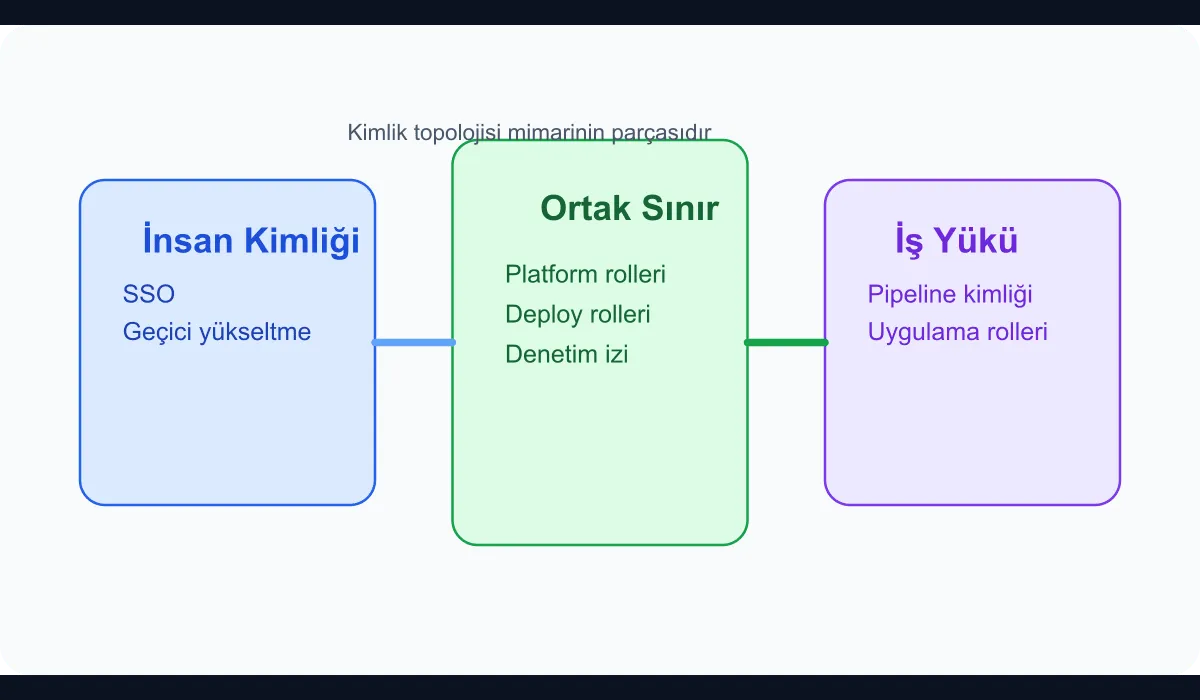
What does the shared identity boundary solve?
A common bad pattern in enterprise structures is this: the central platform account reaches everywhere, and product teams indirectly use that power when needed. It looks practical at first; but over time the following problems appear:
- It becomes unclear who uses which role and why.
- Access trails lose meaning during an incident.
- Environment separation stays only on paper.
- Third-party tools accumulate excess persistent authority.
Shared identity boundary design rewrites the trust relationship between platform and product teams. The goal is not to centralize every authority but to make the lifecycle and impact of identity governable.
The principle of good design: identity matters as much as topology
In multi-account cloud setups, everyone talks about VPC separation, subnet design, or transit gateway. Yet the actual control layer running on top of these is identity. Which service deploys to which account, which pipeline takes on which role, who gets temporary access during a break — the answers to these questions are part of the architecture.
The approach I recommend rests on three boundaries:
- Human identity is separated from workload identity.
- The day-to-day operations role is separated from the emergency role.
- Cross-environment trust relationships are written with the minimum necessary authority.
Without this framing, a “central IAM standard” only turns into a growing permission list.
What should the platform account do, and what should it not do?
Platform teams naturally want broad access for bootstrap, observability, shared network services, and security guardrails. That need is real. But it is not the right model for the platform account to carry continuous administrator authority over every product.
A healthier approach is this:
- The platform account manages shared services.
- Product accounts are responsible for their own workload lifecycle.
- The central pipeline only assumes the defined deployment roles.
- Elevated access used during a break is opened through a separate audit and approval flow.
This separation does not lower trust; on the contrary, it makes the boundaries of why the platform team is critical visible.
Why must workload identity be handled separately?
In current cloud architecture, the actual movement is performed not by humans but by automation. CI/CD pipelines, scheduled tasks, integration services, and agents continuously use identity. Therefore, workload identity design cannot be left as a secondary concern.
The following rules give strong results in practice:
- Each pipeline assumes its own environment role.
- Observability or backup agents use shared but narrow-scope roles.
- Cross-account access is granted only through an explicit trust relationship.
- Secret access is limited to the application identity; human access goes through a separate flow.
This model reduces the kind of invisible risk where “the same key works everywhere.”
How does the shared identity boundary make audit easier?
What audit teams need is not to read thousands of permission lines. The actual need is to be able to understand the intent of a decision. If role names, trust relationships, and access flows align with architectural boundaries, the audit conversation moves out of the technical weeds and rises to the governance level.
For example, the answers to the following questions become easier:
- On behalf of which team does this role act?
- Is a human using it, or automation?
- Is this normal operation, or an emergency?
- Why was this access set up between which accounts?
When the identity model speaks to the architecture, the friction between the security team and the platform team noticeably decreases.
The most common mistake: copying the org chart into IAM
Many organizations draw the identity boundary not according to the technical flow but according to the org chart. As a result, role names look like the management structure but do not describe the actual service relationships. Yet as account, environment, and service lifecycle change, the org chart changes too. Building architectural boundaries with organizational names rots quickly.
A better approach is to write roles and trust relationships along these axes: environment, workload type, domain, and operations level. This way, naming becomes less affected by internal company changes.
Conclusion
In the enterprise cloud, shared identity boundary design is not just an IAM cleanup task. This design determines in which areas platform teams stay central, in which areas product teams take real ownership, and where security policy protects without slowing operations. When identity topology is designed as deliberately as network and account topology, the cloud architecture finally becomes readable.