
In enterprise cloud environments, the most delicate balance is the one between speed and the security of privileged access. During an incident you need fast access to the management account; but keeping that same account permanently open with broad permissions weakens the security model in a lasting way. A break-glass access vault architecture takes this tension out of the “speed or security” dilemma. The goal is not to forbid emergency access, but to grant it through an auditable, short-lived, and clearly owned channel.
Why is a permanent admin account a poor compromise?
In many organizations, a few accounts are kept permanently elevated under the banner of emergency access. That way teams do not have to fight the system in a crisis. But the cost of that comfort is high:
- The question of who can use this account, and under what conditions, becomes blurry
- Over time these accounts start being used in routine operational work
- Discipline around MFA, approval, and logging loosens
- The real chain of ownership cannot be traced during audits
Eventually the break-glass account stops being an exception and turns into a shadow management plane.
What does the access vault solve?
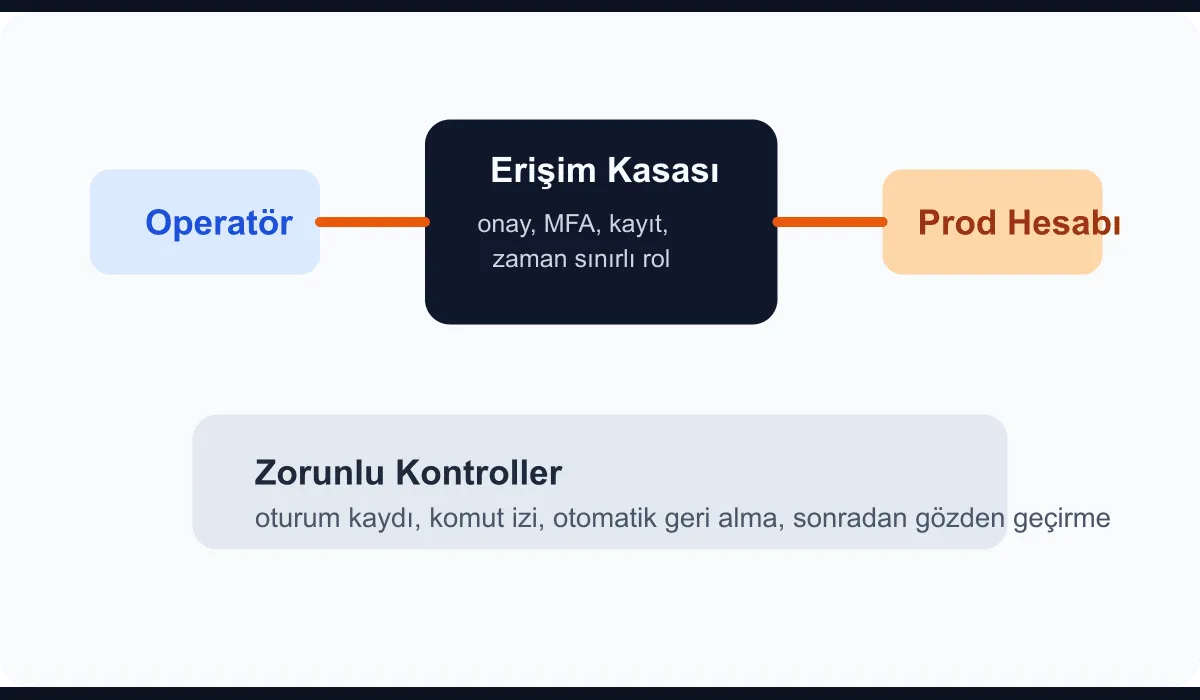
What I call an access vault separates the privileged credential — or the mechanism that mints permissions — from production usage. The operations team normally works with narrower roles. They receive additional permissions only under defined conditions, for a limited time, and with strong audit traces.
The core components of this architecture typically include:
- A separate management account or security tenant
- A two-step approval flow
- Short-lived sessions or just-in-time role generation
- Session recording and command auditing
- Automatic revocation after expiry
This approach safeguards both how the permission is stored and how the activation process is run.
In what order should the architectural decisions be made?
In practice, the right ordering comes from these questions:
- For which systems do we genuinely need break-glass?
- Is a temporary role enough instead of permanent root-like access?
- Who will approve, and who will observe?
- Which records are mandatory during the session?
- What review cadence will run after the access?
This order matters. Many organizations rush to a tool choice and only later think about the operating model. By then the tooling exists, but the governance is missing.
How is the boundary drawn in multi-account cloud setups?
In enterprise environments, break-glass access does not target a single account. Production, security, network, observability, and backup domains may live in different accounts or subscriptions. So the emergency access plane must also be designed centrally.
A pattern that works well in similar environments is:
- The management vault is kept separate from production accounts
- Pre-defined recovery roles exist for each domain
- The duration and scope of the grant differ by role
- The recovery role is fully separated from regular CI/CD identities
That way, instead of an “where is the password for which account” panic during an incident, you have controlled role activation.
Common mistakes in failed break-glass designs
These mistakes show up frequently:
- The same account is used for both daily operations and emergency access
- What is done after access is granted goes unmonitored
- Side permissions opened during the emergency role remain even after expiry
- A recovery procedure that has not been rehearsed for years exists only on paper
Designs of this kind look reassuring, but during a real incident either they do not work or they generate more risk than necessary.
Are drills mandatory?
Yes, because the break-glass flow is not a theoretical artifact but an operational capability. When left untested, two problems emerge: either the process is too slow in practice, or people skip the official flow during panic and fall back on old shortcuts.
For that reason, scenarios like these should be exercised at regular intervals:
- Recovery access during identity provider outage
- Console-level intervention during network partition
- Rollback authority for a misapplied policy
- High-risk access review after a security event
Drills test not just the technical mechanism but also the discipline reflex of the organization.
Conclusion
In enterprise cloud, a break-glass access vault architecture makes privileged access more secure without sacrificing speed. When permanent broad permissions are replaced with temporary, logged, and clearly owned access flows, both incident response and audit quality improve. Secure organizations are not the ones that ban emergency access; they are the ones that design it as an exception and operate it as one.