
When enterprise network teams talk about BGP, the conversation usually centers on capacity, failover, and segmentation. Yet at the internet edge, in partner connections, or across multi-transit setups, another factor turns out to be more decisive: the trustworthiness of the routing information itself. Route leaks, incorrect origin announcements, or accepting the wrong prefix are not just operator concerns — they directly shape the boundary an enterprise draws with the outside world. That is exactly why RPKI deserves a place on the agenda of enterprise architects, not only service providers.
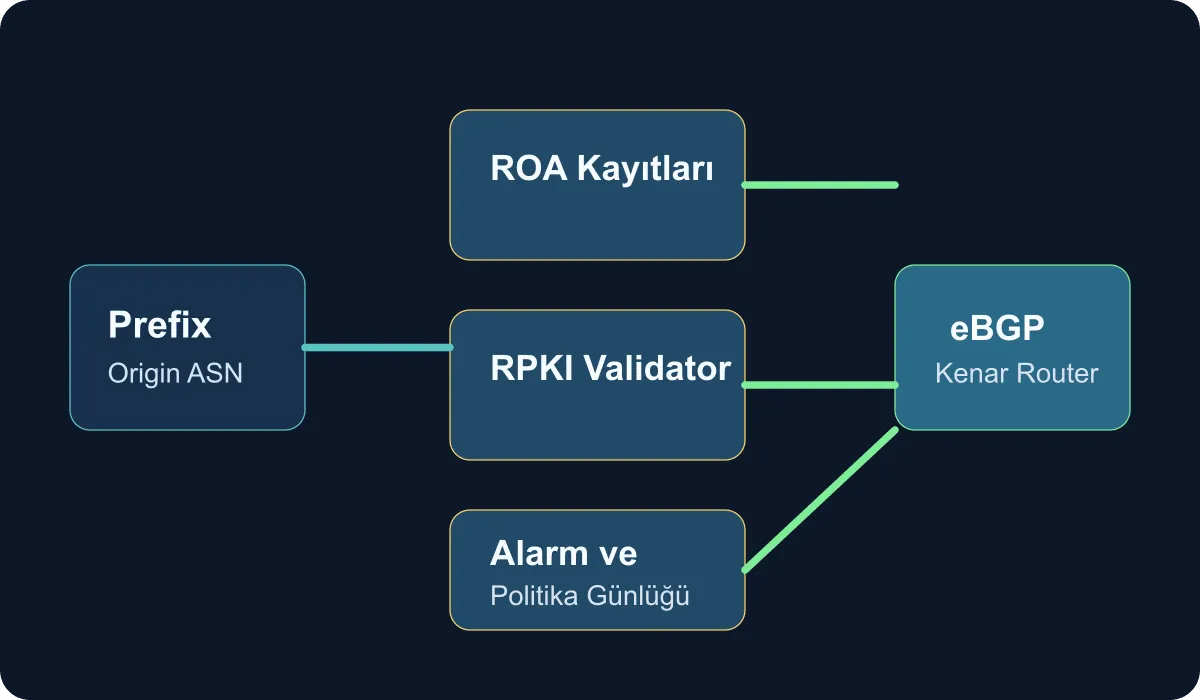
Why has RPKI become important on the enterprise side?
Because enterprises are no longer closed environments with a single uplink. SD-WAN exits, cloud direct connect circuits, DDoS scrubbing providers, edge services, and partner backbones all touch the same routing space. In that topology, accepting a prefix with the wrong origin can lead to:
- Traffic unintentionally reaching a third party
- Partial outage on external access
- Disruption to DDoS mitigation routing policy
- Hours of ambiguity during root cause analysis
RPKI does not eliminate this problem completely; what it does is provide a stronger answer to the question “which ASN is authorized to announce this prefix.”
How does the trust chain work?
In the RPKI model, the prefix holder publishes a ROA record that states which ASNs may announce that prefix as the origin. A route validator pulls this information and produces three core outcomes for routers:
- Valid: The prefix and ASN match correctly
- Invalid: The announcement contradicts the ROA
- NotFound: There is no verifiable record for this prefix
In an enterprise architecture, the goal is to feed this outcome into your policy engine, especially at the internet edge and on critical partner eBGP sessions.
Should every invalid route be dropped automatically?
No, particularly during the transition period this requires care. Your own prefixes, cloud provider announcements, and DDoS scrubbing flows all need to be considered together. I find a three-stage model healthier:
- Start with visibility only: track the count of invalid prefixes
- Then deprefer them on lower-risk edges
- Finally reject at the critical internet edge
A hard policy change made without this transition can needlessly cut off legitimate paths whose ROA definitions are simply incomplete.
Where does the validator sit in an enterprise topology?
Thinking of the validator as something near a single network device falls short. A better model looks like this:
- A dual-instance validator service
- Operating in a separate management segment
- Feeding routers via RTR or an equivalent protocol
- Producing visibility through metrics and alarm integration
In this way, RPKI stops being a one-off security project and becomes a living layer of routing control. Especially when there are multiple data centers or a hybrid edge, validator reachability needs to be part of the design.
Which organizations see returns faster?
In the following environments, RPKI investment pays off more quickly:
- Organizations with their own public ASN and prefix space
- Setups using more than one transit or upstream provider
- Teams steering traffic through DDoS scrubbing services
- Network organizations that jointly manage partner, MPLS, and the internet edge
In these setups, the ambiguity caused by route leaks pushes operational cost up significantly. RPKI at least narrows down problems in the “wrong origin” class.
What should the operating model look like?
I view this as shared territory between network, security, and platform operations. A solid model needs the following clearly defined:
- Who creates ROA records and who approves them?
- Is the trust chain part of the checklist when allocating new prefixes?
- Who owns the incident when an invalid route appears?
- How is the exception process handled on partner connections?
Without answers to these questions, RPKI ends up as a layer that looks “active” but no one really owns.
Conclusion
Building an RPKI-based BGP trust chain in enterprise networks does not make routing fully secure; it adds a critical verification layer. Issues like route leaks, wrong origins, and incorrect prefix acceptance become visible before they grow. In setups with multiple edges, hybrid cloud, and partner connections, this visibility translates directly into operational quality. In modern network architecture, trust is built not only with ACLs and firewalls, but also through the discipline of validating the route itself.