
In enterprise networks, DNS is most often viewed as merely a helper service; in fact, it is one of the most critical control points both for an attacker and for the operations team. Sharing the same resolution layer across the user network, the database segment, the management network, and the integration corridor looks clean in the short term; over time, however, visibility, security, and debugging quality all degrade. The healthier approach is to define resolution behavior per segment and to back it up with a DNS firewall policy.
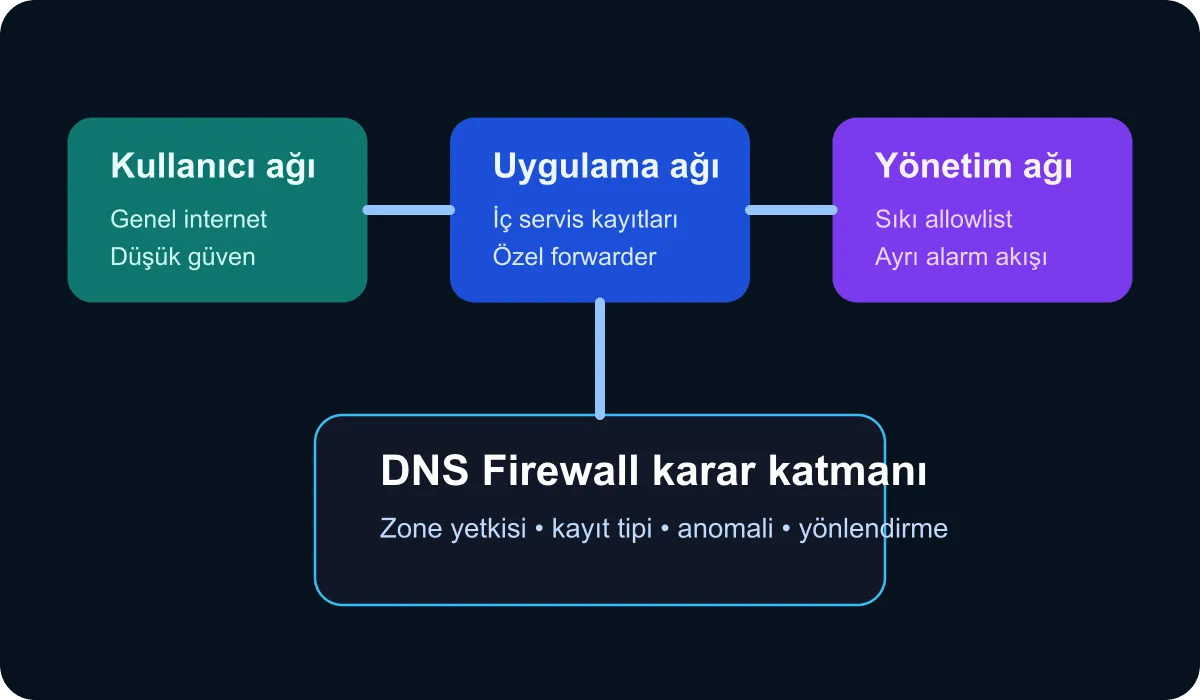
Why does a shared resolution layer produce risk over time?
Because every segment has different resolution needs. The user network frequently reaches internet-based SaaS targets, while the ERP application tier depends on internal service records and integration endpoints. The management network must resolve a smaller but more sensitive set of names. When these differences are gathered into one cache, one policy, and one log stream, the following problems grow:
- Permission surfaces become unnecessarily broad.
- Misconfigured clients spread their problem across the entire network.
- Investigating later which segment a suspicious query came from becomes harder.
- The lifecycle of internal names and external names gets entangled.
In the end, even though the DNS layer looks healthy, it actually blurs trust boundaries.
What does segment-based resolution mean?
This approach does not mean physically deploying a separate resolver for every VLAN or subnet. The core idea is to separate resolution behavior according to the trust profile of the segment. It is more accurate to think of this in three primary layers:
- Client class: User, server, management, integration, or non-production environment.
- Policy layer: Which segment may access which zone, which forwarder, and which record types.
- Audit layer: Logging and alerting for suspicious query patterns, data-exfiltration risk, and policy violations.
In this model, the firewall operates not only at the IP level but also at the level of name-resolution behavior.
What exactly does a DNS firewall do here?
The DNS firewall concept is most often understood only as domain block lists driven by threat intelligence. Yet in enterprise use it has a broader role:
- It rejects zone queries the segment is not authorized to ask.
- It limits abnormal record types that carry data-exfiltration risk.
- It flags high-volume or tunneling-like query behavior.
- It steers the resolution flow between the internal resolver, a dedicated forwarder, or the internet egress.
For this reason, the DNS firewall is a decision point that sits between traditional network security and service discovery.
Why is this critical for ERP and enterprise applications?
In ERP ecosystems, the resolution flow is not only about whether the application starts up. External integration endpoints, license services, file-transfer destinations, reporting layers, and backup dependencies all pass through the same name-resolution plane. If the integration segment is open to free internet resolution, the following problems appear:
- Silent traffic to unapproved targets can begin.
- The application team cannot tell a network problem from a DNS policy problem.
- Disaster-recovery tests reveal unexpected external dependencies.
- Cache effects after a change lead root-cause analysis astray.
For this reason, the resolution policy is an invisible but effective control surface in ERP architecture.
Healthy design principles
The approach I find most useful in practice consists of these principles:
- Create separate resolution policy groups for user, server, and management segments.
- Do not mix internal zone resolution with external internet resolvers.
- Ship resolver logs to the central telemetry pipeline tagged with the segment.
- In critical segments, allow only permitted record types and forwarder targets.
- Observe DNS cache behavior in a way that aids incident analysis.
The aim here is not to build an over-fragmented infrastructure, but to make behavior readable.
What does it gain on the operations side?
The segment-based resolution model both improves security and simplifies operations. For example, when an application team says “service not found,” the following questions are answered more quickly:
- Is the client coming from the wrong segment?
- Is it making an unauthorized zone query?
- Is the internal resolver forwarding to the right target?
- Is the issue a cache effect or the authoritative DNS layer?
This visibility significantly reduces the classic “the problem isn’t on our side” loop between the network team and the platform team.
Conclusion
In enterprise networks, segment-based resolution with a DNS firewall is not just adding a security product; it is making resolution behavior an active part of the enterprise architecture. When the segment’s needs, trust profile, and audit requirements are designed together, the DNS layer turns into a quieter but more powerful control surface. Especially in ERP, management, and integration networks, this approach lowers risk and shortens diagnosis time.