
In enterprise networks DNS is most often treated as a reachability concern, not a trust concern. Yet in modern organizations the resolver chain does more than resolve names; it effectively decides which zone is considered trustworthy. A DNSSEC-validating dedicated resolver layer is therefore not a performance optimization but a trust boundary design. The aim is not to expose direct internet validation to every client; it is to consolidate trustworthy validation into a controlled, observable, and operable resolver layer.
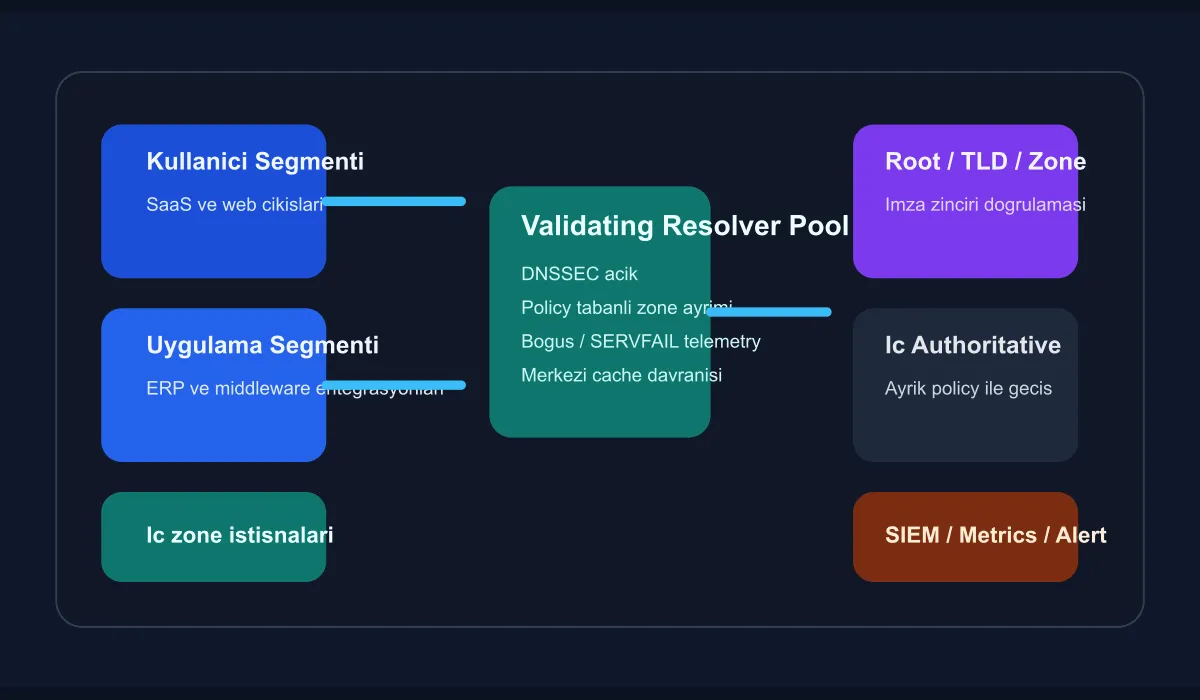
Why is the existing resolver chain not enough?
In many organizations clients hop through a chain of domain controllers, cache forwarders, cloud resolvers, and security proxies. The model can work, but where exactly which validation happens is usually opaque. DNSSEC may be off in some places, broken in others, and transparently passed through somewhere else.
The result is:
- Teams cannot read the difference between signed and unsigned zone behavior
- When a signature breaks, it is unclear which layer dropped the query
- The security team treats spoofed-response risk as theoretical, while the operations team can defer it citing performance
- In hybrid topologies, on-prem and cloud clients resolve at different trust levels
So the issue is not merely supporting DNSSEC; it is standardizing trust behavior at the enterprise scale.
What does a dedicated resolver layer give you?
In this model DNSSEC validation is not spread across every client. Instead, a dedicated resolver layer performs validation only on resolution flows crossing the external or trust boundary. Internal corporate zones are handled with a separate policy. So you can be strict where the signature chain is meaningful, and behave in a controlled way for internal private namespaces.
The dedicated layer brings these benefits:
- Validation behavior becomes central and observable
- Broken delegations affect the resolver layer, not the client
- During a security event, you can read which queries were rejected and why
- The internal zone and the internet zone are not forced into the same control logic
In this way DNS trust moves out of assumptions scattered along the network edge and becomes an explicit architectural decision.
Which distinction matters in the design?
The most important distinction here is not conflating the authoritative role with the validating recursive resolver role. Enterprise teams sometimes assume that adding a few settings to an existing forwarder chain solves the DNSSEC problem. But for a secure model these boundaries must be clear:
- Internal corporate zone management
- Internet recursive resolution
- DNSSEC validation policy
- Telemetry and error classification
Without that separation, when something goes wrong the resolver layer becomes a gray zone where both the security team and the application team point fingers.
Which traffic does it especially help?
I find this approach especially powerful in these areas:
- Client segments with heavy outbound traffic to internet SaaS dependencies
- Threat intelligence or update domains used by security products
- ERP or middleware layers depending on external services through API integrations
- Package fetches from a management network, repository access, and signature verification flows
In these flows the impact of spoofed responses, poisoned caches, or broken delegations can be silent. A dedicated DNSSEC-validating layer reduces that silence and makes incident analysis easier.
How is the operational cost kept under control?
DNSSEC validation is sometimes deferred citing performance or complexity. In reality, most of the cost is not CPU; it is the operating model. If you think these through up front, the cost becomes defensible:
- Per-resolver explicit telemetry:
SERVFAIL, bogus, and validation failure rates - Observing cache policies alongside validation behavior
- Keeping internal zone exceptions written down and time-bound
- Test queries and drills for broken delegation scenarios
In other words, the resolver layer must not be run as a “we set it up and we are done” thing; it must be managed as a security control. Otherwise the very first DNSSEC incident will see the whole setup turned off and trust lost.
A common mistake: forcing everything through validation
In enterprise networks, managing every internal private zone with DNSSEC logic is usually unrealistic. Some zones come from Active Directory, some from temporary lab environments, and some from split-horizon setups. The dedicated layer approach is valuable precisely for this reason: it does not blend internal zone exceptions with secure internet resolution.
A more accurate approach is:
- Separate internal zones with explicit policy
- Apply DNSSEC consistently for internet resolution
- Mark exceptional zones distinctly in telemetry
- Write the fail-open versus fail-closed decision explicitly per use case
With this clarity, both DNS operations and security audits become more defensible.
Conclusion
A DNSSEC-validating dedicated resolver layer in enterprise networks is the pragmatic way to lift trust in name resolution without spreading it down to the clients. Its value lies not just in validating the signature chain, but in turning trust behavior into a central, observable, and explicitly excepted design. Strong resolver architecture starts here too: not just in giving a fast answer, but in being able to defend the trust boundary of that answer at the enterprise scale.