
For enterprise network teams, one of the most expensive problems is not writing the wrong rule but realizing too late which rule is actually in effect. Firewall rule sets, routing policies, NAT exceptions, and segment crossings stack on top of each other over time. The documentation looks current, the change record is kept properly, automation is even in place, and yet the production network still drifts away from intent. We call that drift policy drift.
Why is a classic CMDB approach not enough?
A CMDB or rule inventory records what the network is supposed to be. The drift problem is about how the network actually behaves. Especially in multi-vendor enterprise topologies the following gaps emerge:
- The same intent gets implemented with different syntax across devices
- A temporary incident rule becomes permanent
- Route preferences end up bypassing the expected security path
- A new segment is opened but old exceptions are never cleaned up
So looking only at the configuration list is not enough to catch behavioral drift.
What does the digital twin layer do?
The digital twin layer models the device state, topology information, and policy intent of the production network and makes it queryable. The goal is not to build a flawless lab that emulates production; it is to produce a control surface that surfaces the meaningful difference between change and current state.
This layer typically draws from three sources:
- Live configuration and state pulled from devices
- Intent definitions or policy repositories from the source code
- Flow tests, reachability, and path validation outputs
When this data is gathered into a single model, you move from “which rules exist?” to “which traffic, under which conditions, can go where?”
Where does it create value?
The digital twin approach is particularly strong in these areas:
- Seeing the actual effect of segmentation policy
- Finding implicit transitions between security zones
- Performing impact analysis before a firewall change
- Verifying whether a routing change broke the security chain
- Showing intent and real behavior side by side during an audit
This way the network team stops being just the team that manages configurations and becomes a team that manages behavior.
Which model should you build?
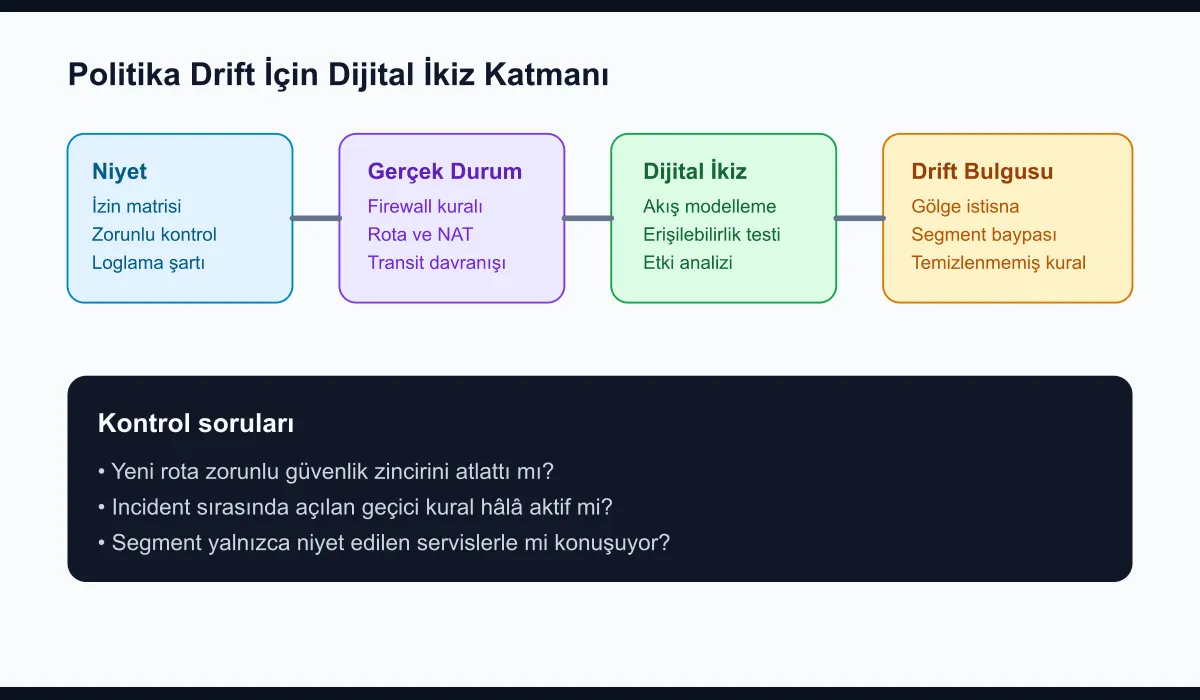
In practice I have seen a four-layer model work well:
- Intent layer: Inter-segment permission matrix, mandatory inspection points, mandatory logging rules
- Topology layer: Devices, VRFs, VLANs, transit networks, service chains
- Realized policy layer: ACLs, firewall policies, route-maps, NAT, and service insertion rules
- Validation layer: Flow tests, path resolution, and violation reports
Without this distinction the digital twin tool becomes just a configuration archive. The value lies in being able to show the gap between intent and realization.
Which questions should you ask?
A solid control plane should be able to answer questions like:
- Can this segment really only talk to permitted services?
- Are networks forbidden from reaching the internet still getting indirect egress?
- Did the new route bypass a mandatory security control?
- Have two policies been created that contradict each other for the same service?
- Is a temporary rule opened during an incident still active?
If the answers to these questions are not visible, segmentation claims rest largely on assumption.
How should the operating model be set up?
The digital twin layer is not a standalone network architecture project; it has to be wired into the change process. The healthiest model is usually:
- Policy changes are simulated in the twin before merge
- Critical changes deployed live overnight go through a drift scan the next day
- Open violations and temporary exceptions are reviewed in a weekly report
- Audit teams use model output instead of device screenshots
In this way the digital twin becomes part of change management, not a side tool that lives outside operations.
Conclusion
A digital twin layer for policy drift in enterprise networks is a strong approach to noticing networks that look fine on the surface but have drifted behaviorally. Its value lies not in centralizing device counts but in continuously surfacing the gap between intent and the actual flow. Network maturity also begins right there: not just in being able to write rules, but in being able to defensibly show how the rule you wrote actually behaves in the field.