
When ERP modernization or a core version upgrade comes up, the most common mistake is treating the integration side as a single on-off decision. Yet the reporting, warehouse, manufacturing, finance, identity, B2B, and data lake flows running around an ERP do not share the same risk profile. Pushing every integration into the new behavior at once after the core is updated may be technically possible, but operationally it opens a fragile path.
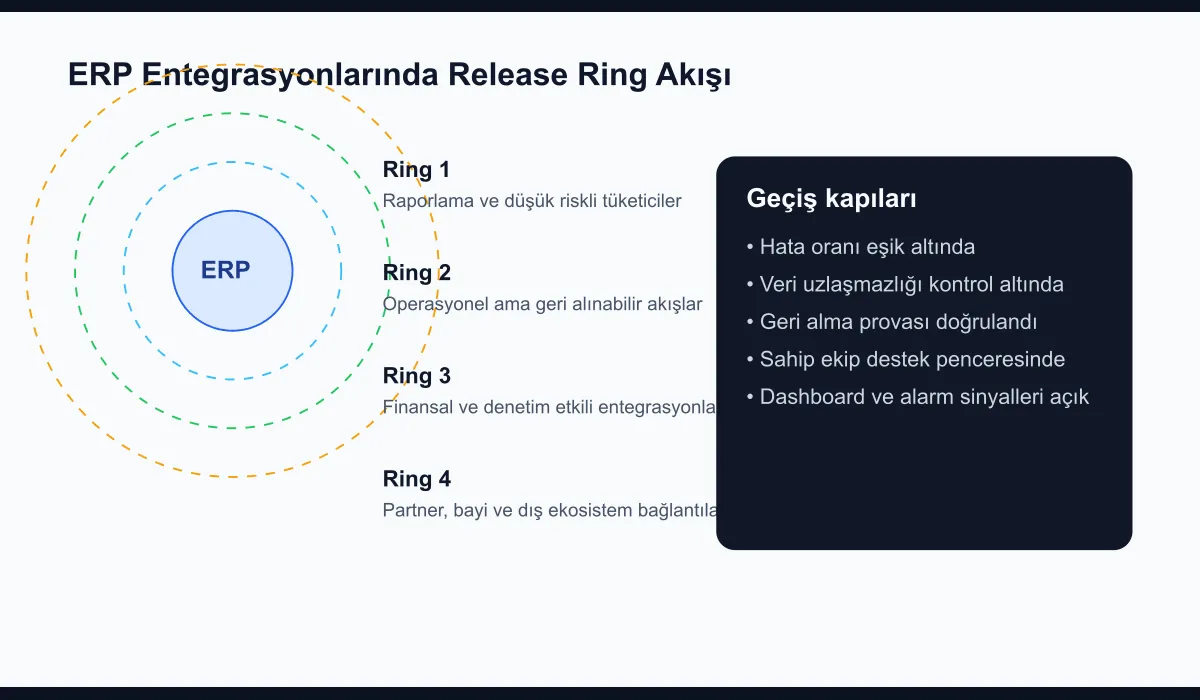
Why does the release ring approach work?
The release ring idea is about expanding a new version or a new integration contract through controlled rings instead of opening it to everyone at the same time. The method, familiar from cloud platforms and client software, is even more valuable in ERP integrations. Because here we are talking not only about application compatibility but also about the continuity of the business workflow itself.
In general, it offers the following benefits:
- Early validation against low-criticality flows
- Cleaner reading of observability signals
- Rollback decisions can be made without affecting the entire organization
- Partner or internal team dependencies are resolved in a more controlled way
How should rings be defined in the ERP world?
You can define rings by geography, business unit, or technical integration type. In most enterprise setups I find the following split more defensible:
- Internal technical ring: Reporting, low-risk batches, observability and test consumers
- Operational ring: Time-sensitive but reversible flows such as warehousing, planning, and field operations
- Financial ring: Integrations that touch accounting, invoicing, collections, and audit
- External ecosystem ring: Dealer, supplier, EDI, and partner connections
This ordering helps you catch a fault on the cheapest surface and stop it before it grows.
What should travel between rings?
Carrying just the code or integration package is not enough. Each ring transition must also bring along:
- Observability dashboards and error thresholds
- The data contract version
- The rollback condition
- Support and incident ownership
- Success criteria for transition approval
Without this scaffolding, a ring transition is not really a staged release; it is just a slow blanket release.
The most common design mistake
The most widespread mistake is reducing rings to calendar boxes. Plans like “Monday is ring one, Tuesday is ring two, Wednesday is everyone” have ring logic on paper but no decision gates. Yet at every transition there must be a clear answer to the question, “What signal justifies promotion to the next ring?”
These signals can include things like:
- Message failure rate must stay below a defined threshold
- Data reconciliation discrepancies must be near zero
- The operations team should not need manual fixes
- A rollback drill must be proven for the relevant ring
Why does observability play a central role?
In ERP integrations, faults rarely arrive as hard breaks. They surface as partial data loss, delayed reconciliation, duplicate records, or queue buildup. For ring transitions, the following signals are therefore especially critical:
- End-to-end latency
- Queue depth
- Failed message rate
- Reprocessing counts
- Data inconsistencies relative to transaction volume
Without these measurements, the ring approach looks reassuring but the decisions are still made on intuition.
What should the enterprise communication model look like?
The ring approach should not stay confined to the infrastructure team’s internal design. Business units and integration owners must know which ring they are in, what is expected to advance to the next ring, and what happens in case of rollback. This visibility especially builds trust on the ERP side, because stakeholders see controlled progress instead of surprises.
Conclusion
Rolling out integrations through release rings in ERP infrastructures is an effective way to mature risky core changes via controlled rings rather than spreading them across the organization in a single step. When designed well, it does not produce a slower transformation, but a more predictable one. ERP success is often measured precisely there: not in the ability to flip an integration on, but in the disciplined management of opening sequence and stop thresholds.