
For many years, ERP systems were designed around nightly batch windows. End-of-day reconciliation, stock synchronisation, transfer jobs that run before financial close and external system integrations all happened inside fixed time blocks. That model still works in plenty of organisations, yet as expectations for real-time operation grow, the batch window starts producing both technical debt and operational bottlenecks. The answer is not to rewrite ERP overnight; it is to narrow the batch dependency at the architectural layer.
Why does the batch window cause trouble?
Because accumulated workload also stacks the risks at the same time. When the nightly flow stretches out, operations teams meet the following effects:
- By the time an error is noticed, there is no time left to recover.
- A single bottleneck delays the entire chain of work.
- The business impact stays invisible until morning.
- Capacity is sized for the peak load and ends up oversized for daily use.
Especially in companies with heavy warehouse, logistics and finance integrations, this becomes more than a technical issue and turns into direct commercial risk.
What does batch-window-free architecture actually mean?
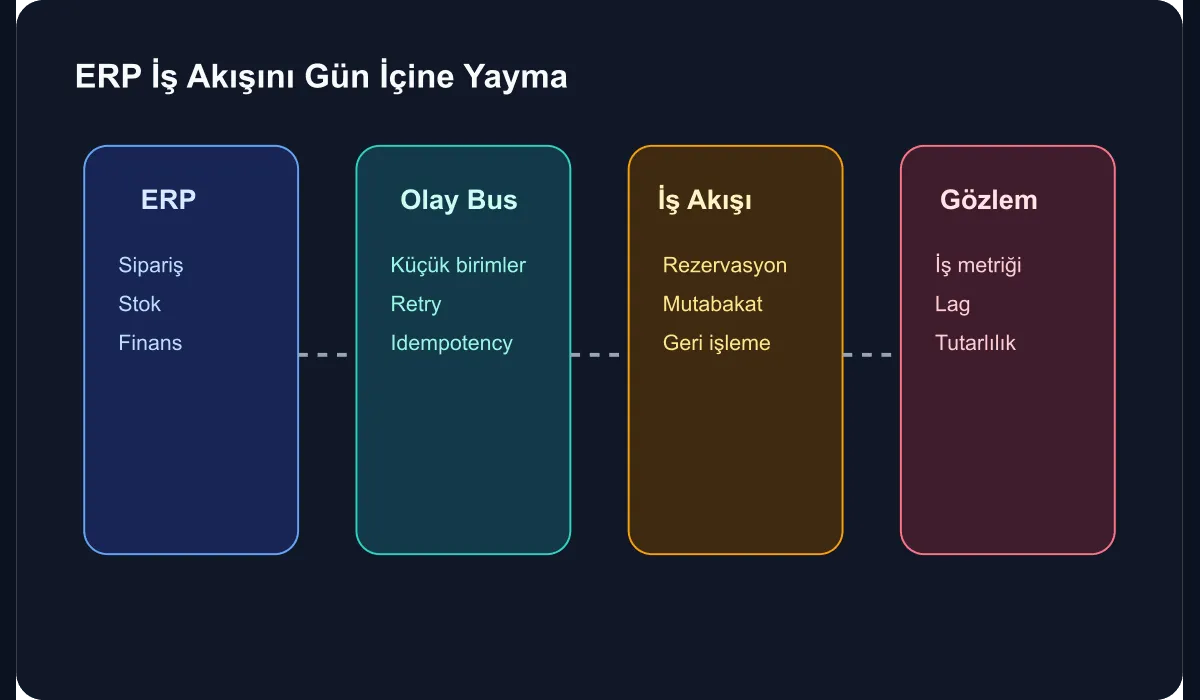
The phrase does not imply running everything instantly. A more accurate definition is this: only leave workloads that genuinely need to be processed in bulk as batch, and turn the rest into small, observable chains of events.
In practice the transition advances through these layers:
- Operations that produce changes are exposed as events.
- Asynchronous consumers run idempotently.
- Heavy reconciliation jobs are squeezed into narrower time blocks.
- Workflows are monitored not only by technical alarms but also by business metrics.
This model makes the surroundings of the ERP core more flexible without breaking the core itself.
The most common mistake: renaming batch as a queue
Many teams believe they have solved the problem the moment they add a message broker. Yet if the consumers still behave with hourly bulk-job logic, all you have done is move the old batch onto new technology. The real signal of an architectural transformation shows up in these questions:
- What is the smallest unit that can be processed per event?
- Does the flow stay safe if the same record arrives again?
- Can a failing piece be isolated without stopping the whole chain?
- Can the business impact be observed in real time on a dashboard?
Modernisations that go ahead without answering these questions only refresh the look of the integration layer.
Why is the observability side critical?
In ERP flows, failure usually surfaces in the business outcome rather than in an infrastructure metric. A queue filling up, a rising retry count or a slower API only become meaningful when combined with business context. That is why telemetry in a batch-window-free architecture must carry these together:
- Technical latency
- Transaction volume
- Reconciliation discrepancy
- Failure rate per record
- Backlog size in the reprocessing queue
Without this visibility, the new architecture can become more complex and less understandable than the old batch model.
How should an enterprise transition look?
The healthiest approach is to set up a “strangler” model. Start with a flow that has high business impact yet can be technically isolated. For example, the order-to-inventory update, stock reservations or distribution centre events. That flow is turned event-based, monitored with business metrics and run in parallel with the old batch for a while.
This way the organisation can:
- measure the new behaviour safely,
- validate data consistency,
- get the operations team used to the new rhythm,
- avoid destabilising the ERP core all at once.
Conclusion
A batch-window-free workflow architecture for ERP infrastructures is not a call to “stream everything”. The aim is to reduce nightly pile-ups, shrink the blast radius of errors and split workflows into observable pieces spread across the day. Done well, this approach lifts not only integration speed but also operational reliability significantly during ERP modernisation.