
ERP infrastructures are often discussed in modernisation conversations through the lens of integration, messaging and data flow. Yet the real operational burden tends to live one layer below, buried in how credentials and secret keys are distributed. When batch jobs, middleware layers, reporting services and third-party integrations all reach into the same secret set at different times, the organisation rapidly accumulates invisible security debt.
Why does the problem grow this much?
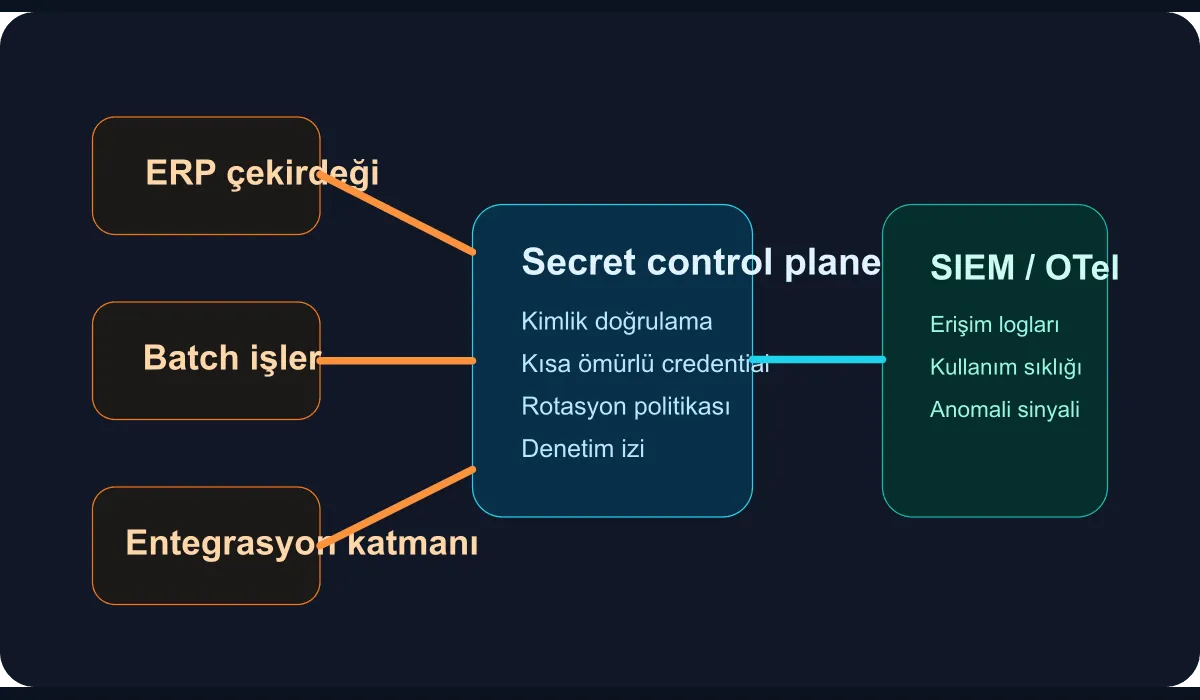
Because ERP ecosystems rarely consist of a single application. Alongside the ERP core, the following layers are usually in play:
- ETL or batch processors
- Integration servers
- File transfer services
- Reporting tools
- Scheduler or agent-based processes
If some secrets sit inside this structure as configuration files, others inside scripts and the rest in vaults shared by the operations team, real ownership and rotation tracking gets lost very quickly.
What does a secret key distribution plane actually solve?
A central distribution plane is more than just keeping secrets in a single vault. The bigger value is that it standardises the consumption model:
- Which application identity is requesting the secret?
- For how long is it valid?
- Who has accessed it and which log entry recorded it?
- When rotation happens, which workflows are renewed automatically?
On the ERP side, this approach makes the lifecycle of service accounts manageable in particular.
What layers should the architecture include?
The model that tends to be useful at enterprise scale typically consists of four layers:
- A central secret vault
- An authentication and machine identity layer
- A distribution agent or sidecar model
- An audit and usage telemetry plane
These layers make both the location of the secret and the way it is consumed visible. For batch jobs especially, the pattern of “fetch a short-lived credential before the task starts and release it when the work is done” significantly reduces risk.
Which design decisions are critical?
The decisions that produce the most value in this area are these:
- Drawing a strict line between human users and service identities
- Preferring short-lived tokens for batch jobs
- Narrowing secret access by application role and environment
- Separating emergency access from the normal flow
- Pushing audit logs to the SIEM or observability layer
A secret solution built without applying these principles ends up being just another vault interface.
How are operational realities handled?
Maintenance windows, dependencies on external systems and legacy clients in ERP platforms mean a fully modern design is not always possible. In that case the transition approach has to be layered:
- First, centralise the most highly privileged static secrets
- Then split integration groups by role
- Next, extend rotation automation to batch and middleware processes
- Finally, migrate legacy applications to the short-lived identity model
This sequence helps the organisation close the most risky point first.
Conclusion
Designing a secret key distribution plane in ERP infrastructures is not a separate control request from the security team; it is a foundational part of business continuity. When secret management stays scattered, integration reliability, audit trail and operational discipline all weaken at the same time. Once the enterprise architecture treats this as a central distribution problem, both security and operability improve substantially.