
In ERP systems, performance problems usually aren’t a code issue. They grow out of bad data-consumption habits. Finance, logistics, inventory and operations teams keep asking for more reports. Integration teams keep opening new queries. The BI side wants near-live data. When all of those needs land directly on the production database, the transactional path and the analytical expectation start competing on the same resource. Designing a reporting replica is a strong way to separate that conflict at the architecture layer.
Where’s the actual problem?
Reporting queries in enterprise ERP environments tend to get dismissed with “it’s just reads, what harm can it do?”. In practice, the effects are:
- Long join and aggregation queries push disk pressure up
- Lock and wait times stretch during peak hours
- Maintenance windows collide with reporting windows
- Application teams quietly turn the production database into an analytics platform
This isn’t sustainable. The ERP core wants transactional safety. Reporting wants broad freedom to read. Optimizing both on the same surface at the same time is hard.
What does a reporting replica mean?
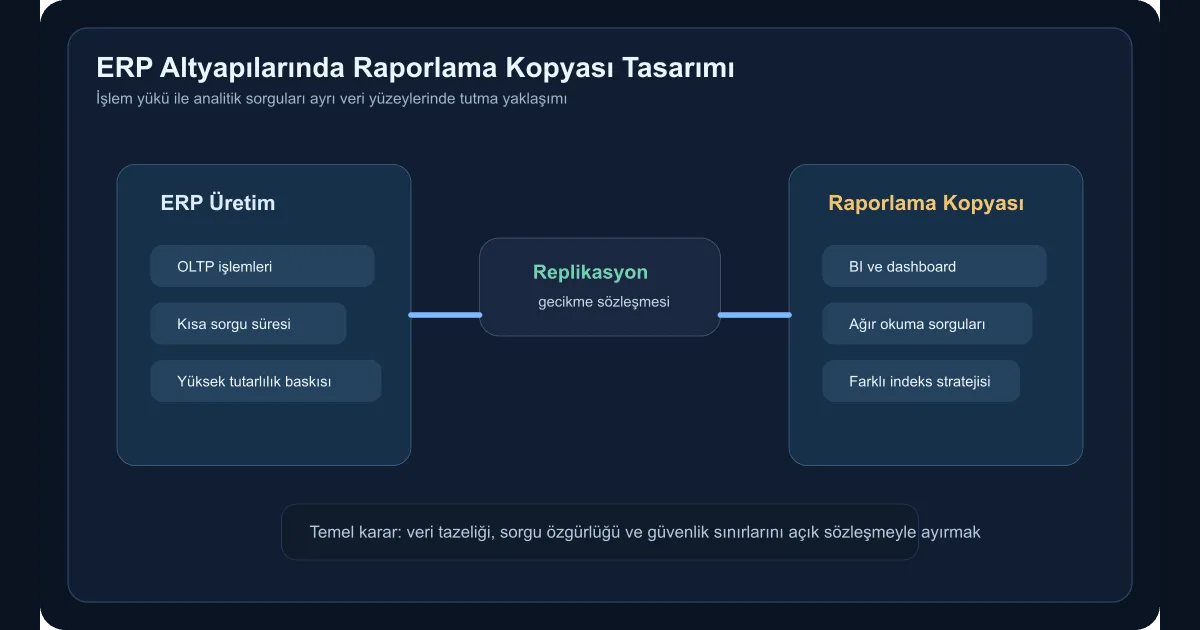
A reporting replica is a separate read surface that pulls data from production but doesn’t share the same operational contract as production. This surface can:
- Be read-only
- Be fed via lagged replication
- Carry indexes shaped for reporting needs
- Offer different query freedom to BI and integration teams
The important part is not confusing this with a backup. A backup is for restoring. A reporting replica is for consumption.
Which design models stand out?
I find it useful to think about this in three models:
- Near-real-time read replica
- Hourly or periodic data copy
- Event-driven analytics surface
The first model fits dashboards and operational reports. The second is enough for closing or daily reporting needs. The third protects the ERP core the most, but it’s the most complex to design.
The most critical decision: data freshness
In a reporting replica design, the most important question is usually not the technology — it’s the latency you accept. Without sorting this out, you can’t really make the infrastructure call:
- Is 5 seconds of lag acceptable?
- Is 5 minutes acceptable?
- Is hourly refresh enough?
When the answer changes, replication cost, network design, indexing strategy, and operational load all change with it. Enterprise environments often have a “everything must be live” reflex. But once you actually talk to the business teams, much more reasonable windows usually emerge.
How should operational boundaries be drawn?
Standing up a reporting replica isn’t an invitation to uncontrolled query paradise. In a healthy model, these boundaries should be explicit:
- Who can connect directly?
- Which classes of queries are supported?
- What’s the retention and masking policy?
- If the replica breaks, how does business continuity get hit?
Especially in ERP data, personal data, financial records, and supply-chain information sit close together. So the reporting surface can’t be designed in isolation from security and data governance.
What gains are realistic?
A correctly built model produces these wins:
- Production transactional load gets more predictable
- BI and reporting teams gain a wider query surface
- Performance reviews can read production and reporting separately
- ERP upgrades and maintenance work can be planned with more control
The critical caveat is that a reporting replica won’t fix every problem. A bad data model, weak query discipline, or reports with unclear ownership still cost you. But at least that cost no longer threatens the core transactional path the same way.
A common mistake
The most common mistake is opening the reporting replica without defining an operating model around it. Eventually everyone connects to the new surface, freshness complaints start, indexes grow uncontrolled, and the system turns into a second production database.
The second mistake is treating the replica as purely a tech-team call. This is also an architectural change that requires an explicit contract with the business on data lag, report accuracy, and the support model.
Wrap-up
In ERP infrastructures, designing a reporting replica isn’t a database scaling trick — it’s a workload separation decision. Instead of forcing core transactional traffic to share a surface with analytics and reporting, splitting expectations through explicit contracts produces a much healthier outcome over time. For enterprise ERP systems, speed often doesn’t come from bigger hardware. It comes from drawing the right consumption boundaries.