
In enterprise networks, segmentation often becomes fragile as the VLAN table grows. As new application zones, management networks, ERP perimeter systems, and security requirements pile up, classic L2 expansion drives operational cost. The BGP EVPN approach stands out here not as a data-center fad, but as a way to manage network segments with clearer ownership, better visibility, and more controlled propagation policies.
Where does classic segmentation struggle?
In many organizations, network segmentation runs on rule layers accumulated over years:
- VLANs get opened up to address local needs.
- ACL rules grow over time.
- L2 extensions, intended as temporary fixes, become permanent.
- Application teams’ dependencies turn invisible at the network layer.
This model is manageable at small scale; but it creates problems when multiple data centers, hybrid cloud connectivity, or high-sensitivity service separation around an ERP environment is required. If the control plane is not clear, neither is the impact of any change.
What does EVPN actually change here?
The real contribution of BGP EVPN is its ability to express intent before any packet moves. Which segment is represented by which VNI, where it lives on which leaf, and under which VRF it is advertised — all of this becomes visible at the control plane. As a result:
- Segment propagation becomes selective.
- Network expansion fits change management more cleanly.
- The amount of broadcast domain being carried shrinks.
- Security and operations teams gain a shared reference model.
This visibility is especially valuable in enterprise architectures for building a common language between the network team and the platform team.
How should the architecture be built?
In practice, the most sustainable model rests on these principles:
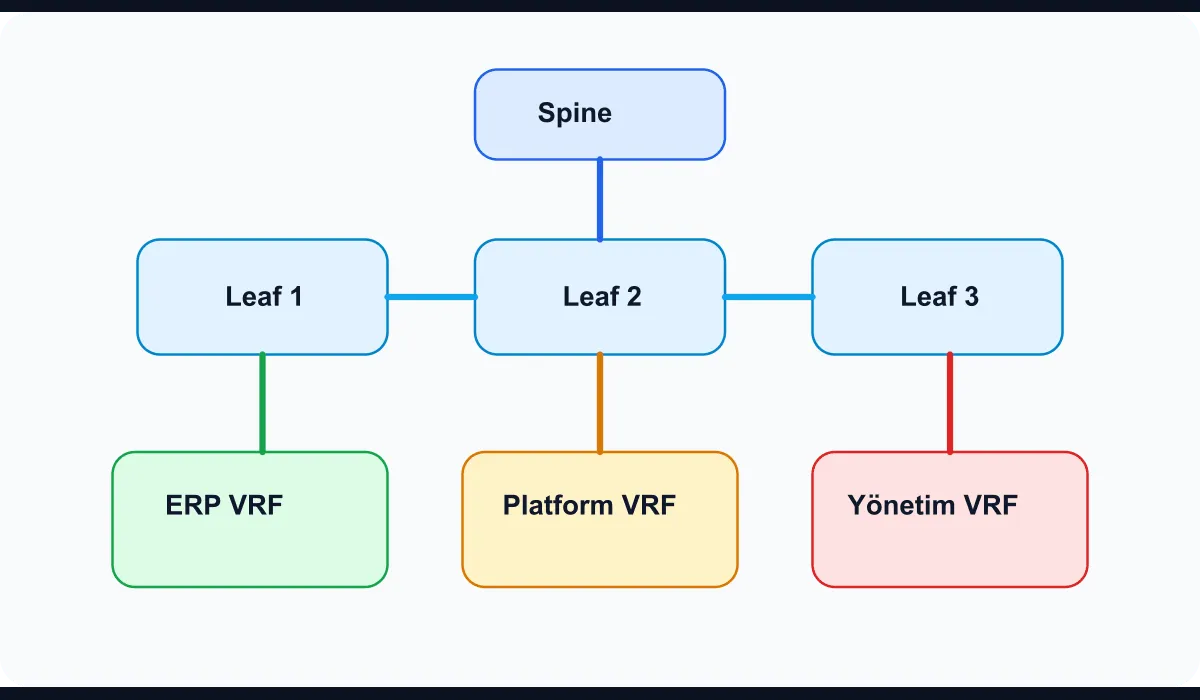
- Let the spine be only the transport and routing backbone.
- Define segment ownership clearly at the leaf layer.
- Align VRF boundaries with the application domain or trust level.
- Manage egress routes to external security layers centrally.
This approach makes segmentation a part not just of network operations, but of the enterprise architecture. The ERP production zone, integration corridor, and management plane can sit on the same physical fabric while remaining logically separated.
Where does it make the biggest difference?
In enterprise environments, the most visible benefit shows up in scenarios like these:
- Secure separation of server clusters within a data center
- Running the ERP core and integration services in different trust zones
- Controlled segment migration to a backup data center or DR site
- Allowing Kubernetes worker networks to talk to legacy data-center services across a clear boundary
In these situations, EVPN matters not just for performance but for limiting the blast radius of changes.
What should you watch for on the operations side?
The operating model is as important as the technology choice. For networks running EVPN, these disciplines are required:
- Maintain a central segment inventory and VNI catalog
- Manage route target policies under version control
- Route every new VRF opening through architectural review
- Monitor BGP neighbor relationships and MAC/IP advertisement behavior on the telemetry side
Even with a strong control plane, human error doesn’t disappear entirely. That’s why visibility and change discipline are essential.
Conclusion
A BGP EVPN segmentation strategy makes enterprise networks not just more modern but more legible. It clarifies why a segment was created, where it propagates, and within which trust boundary it operates. For organizations that want to strengthen the role of the network within their enterprise technology architecture, the real value lies here: not more flexibility, but less ambiguity.