
In enterprise environments, internet egress is often one of the latest-discussed but most expensive decisions in network design. When the first services are launched, a few firewall rules and a handful of NAT entries seem to do the job. Over time, as SaaS connections, update repositories, API integrations, backup targets, and observability agents proliferate, egress behavior turns into an uncontrolled surface. Centralized egress design pulls this scattered exit into a shared policy and visibility layer.
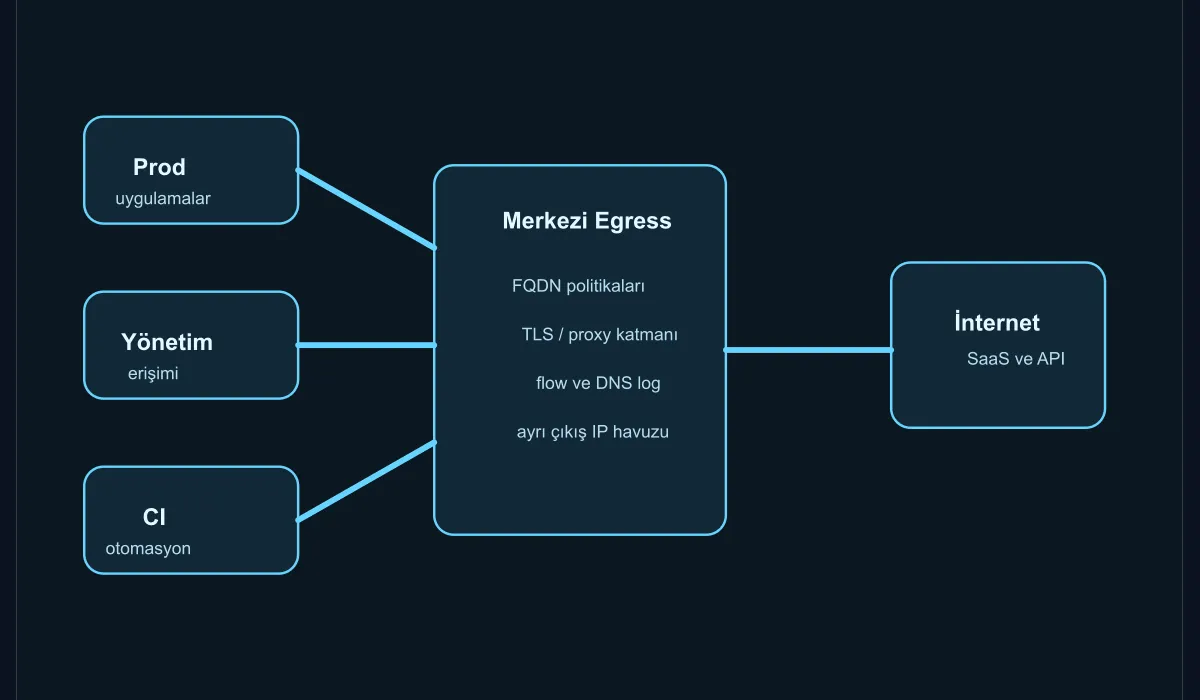
Why should it be considered as a separate architectural layer?
Outbound internet traffic isn’t just web access. In an enterprise environment, the following flows typically share the same external surface:
- Server and container image updates
- SaaS service calls
- ERP integrations connecting to external systems
- Threat intelligence and security signature updates
- Backup or archiving traffic
These flows don’t share the same risk profile, bandwidth need, or logging requirement. Letting each segment manage its own egress quickly produces rule-set sprawl.
What does the centralized egress model deliver?
The main objectives of a sound design are:
- To clearly identify the source of the traffic
- To restrict allowed destinations through policy
- To produce TLS or metadata visibility in a controlled way
- To collect shared logs and flow data for incident review
- To allow regional or per-service egress separation when needed
The aim here isn’t to push everything through a single device; it’s to bring oversight under a single architectural model.
Core components of the design
1. Egress segmentation
Production applications, the management network, CI agents, and user traffic should not share the same NAT pool. Splitting egress IPs makes both security policy and allowlist management on external services much easier.
2. Policy engine
Policy should be applied based on target FQDN, service tag, environment type, and risk level. A purely IP-based ruleset quickly falls short in modern setups that consume SaaS and dynamic services.
3. Visibility layer
Flow logs, DNS logs, and proxy logs should be considered together. Firewall accept/deny records alone don’t paint a meaningful operational picture.
4. Resilience model
The centralized egress layer mustn’t turn into a single point of failure. Dual-region, dual-device, or alternate-path egress strategies should be planned from the start.
Critical decisions in hybrid cloud scenarios
When an on-prem data center and a public cloud are used together, these questions need to be settled:
- Will outbound traffic from the cloud go straight to the internet, or back through the central data center?
- Will SaaS access prefer regional egress, or a centralized security inspection?
- Will internet egress and partner connections be managed in the same layer?
- At which trust boundary will DNS resolution and target validation happen?
Especially for batch integrations around an ERP, it’s a frequent reality that the external system only accepts specific egress IP ranges. So the egress IP plan is as much part of integration architecture as it is of network operations.
What needs to be measured?
Once a centralized egress layer is in place, monitoring shouldn’t stop at device health. From an operational angle, the following signals carry real value:
- Egress volume by service or segment
- Distribution of blocked destinations
- Correlation between DNS queries and actual egress traffic
- Regional saturation and latency
- TLS handshake errors and certificate problems
These metrics produce threat visibility for the security team and capacity and debugging signal for the platform team.
Conclusion
Centralized egress design in enterprise networks lifts internet access beyond the “is there an exit?” level into a manageable architectural component. When source separation, policy discipline, visibility, and resilience are considered together, the security surface shrinks while external dependencies become more controllable. Especially in hybrid cloud, ERP integrations, and audit-heavy environments, egress is no longer an edge detail but a core design decision.