
One of the largest operational misconceptions in in-house infrastructures is to design the network carrying production traffic and management access in a way that they share the same fate. While everything is normal, this approach goes unnoticed; but when a switch configuration breaks, the routing table locks up, or the firewall at the data center edge receives a faulty rule, teams find themselves unable to reach devices precisely when they need to. The out-of-band management plane is designed to mitigate this fragility.
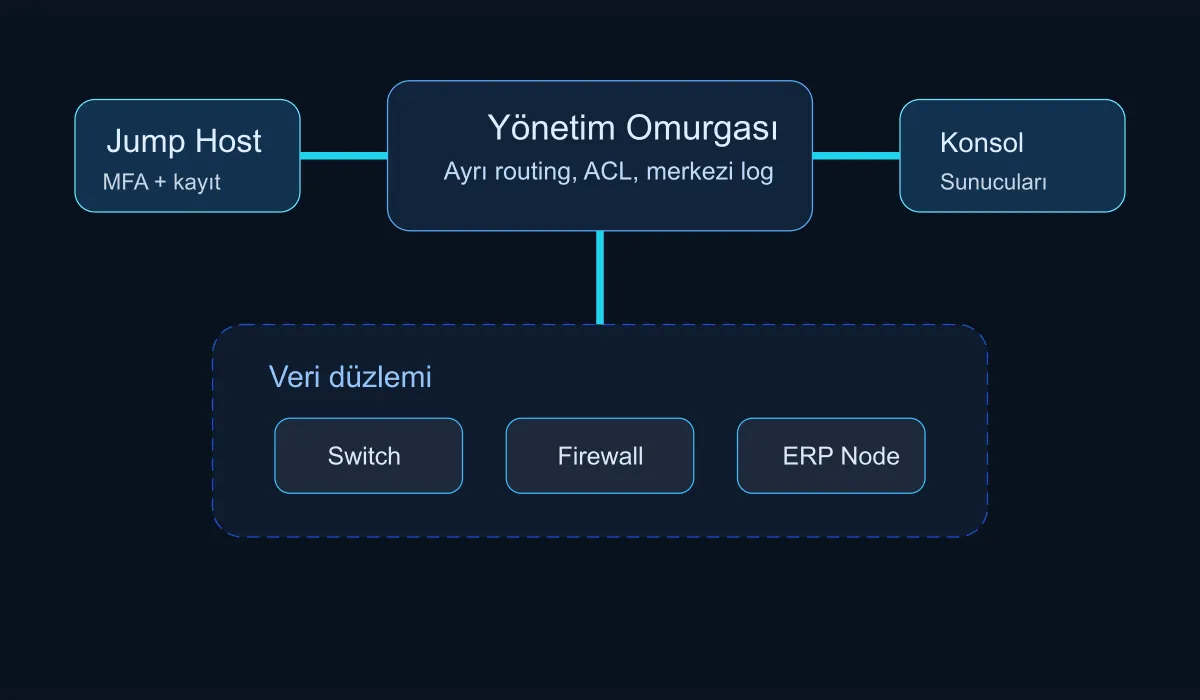
What does the out-of-band approach change?
The core idea of this model is simple: device management interfaces, console ports, and recovery access channels are physically or logically separated from the data plane carrying application or user traffic. That way, even if the production network breaks, the operations teams do not lose the channel they need to bring the infrastructure back up.
In practice, the following components are considered separately:
- Switch, router, and firewall management ports
- Hypervisor and server cards such as iLO, iDRAC, and IPMI
- Console servers and serial access lines
- Jump host or bastion access layer
- Separate monitoring, logging, and identity audit flows
This separation provides not just ease of access but also the ability to make orderly decisions during an incident.
Why is it critical in enterprise environments?
In small environments, having production and management traffic live on the same network is often tolerated. In enterprise environments, however, the picture changes. Because:
- Hundreds of network devices are managed simultaneously.
- Maintenance windows are multi-layered.
- ERP, security, virtualization, and backup teams have different access needs.
- Regulatory and audit teams want a clear answer to who, when, and on which device performed an action.
For this reason, the out-of-band design is not just a network access convenience; it is a business continuity and auditability requirement.
Layers of a robust management plane
1. Separate addressing and segmentation
The management network should not be treated as an extension of production VLANs. It should have its own IP plan, routing policy, and access control lists. In particular, the management interfaces of backbone devices should not be directly reachable from user or application networks.
2. Secure entry point
Every management connection should not open directly to the devices. A central jump host structure that holds identity federation, MFA, session recording, and command history significantly raises the quality of operations.
3. Console recovery line
When SSH or HTTPS access is lost, the serial console connection saves lives. Console servers may seem expensive; yet on a faulty core switch change, they can prevent hours of data center travel.
4. Telemetry and audit
What happens on the management network should be as visible as production. Failed login attempts, unexpected device access, configuration changes, and firmware updates should each generate distinct alarm signals.
Common design mistakes
Many organizations think they have built an out-of-band network; in reality, they have only opened a different VLAN. The following errors are seen frequently:
- The same firewall rule set carries both production and management access.
- There is no jump host; devices are accessed directly from user computers.
- Management interfaces depend on production services due to DNS or certificate dependencies.
- Logs are kept only on the device, with no central audit.
In this case, the network separation exists in appearance, but there is no independence in a crisis.
Applicable architecture principles
For a healthy start, the following sequence works:
- Inventory the management interfaces of all critical network and server equipment.
- Design the management IP plan separately from production networks.
- Pass all access through a central jump host with mandatory MFA.
- Enable serial console access at least for core devices.
- Connect management network access logs to the SIEM and observability pipeline.
This approach moves beyond the “let’s pull a separate cable” level and produces an operable management plane.
Special considerations for server and ERP infrastructures
In enterprise ERP environments, the issue is not only network devices. Database cluster nodes, virtualization clusters, storage controllers, and license-dependent application servers should also be evaluated within the same scope. In particular, losing a storage management interface during a maintenance window can multiply application downtime.
For this reason, the out-of-band approach should be treated not just as a network team’s job, but as a shared architectural standard of data center operations.
Conclusion
The out-of-band management plane is an architectural decision that is invisible during normal times but proves its real value during a crisis. When you unite the network, virtualization, server, and security layers under a single privileged access model, both response times shorten and audit quality rises. This is one of the important components of secure and resilient infrastructure design at enterprise scale.