
In enterprise infrastructures, management access has been built for years around bastion servers, shared admin accounts, and long-lived SSH keys. Although this model is still common, the threat surface is unnecessarily large: questions like who entered which server when, which privilege they used, and how long the session lasted often cannot be fully answered. The ephemeral management access approach establishes a session over short-lived identity and policy decisions instead of persistent network openings.
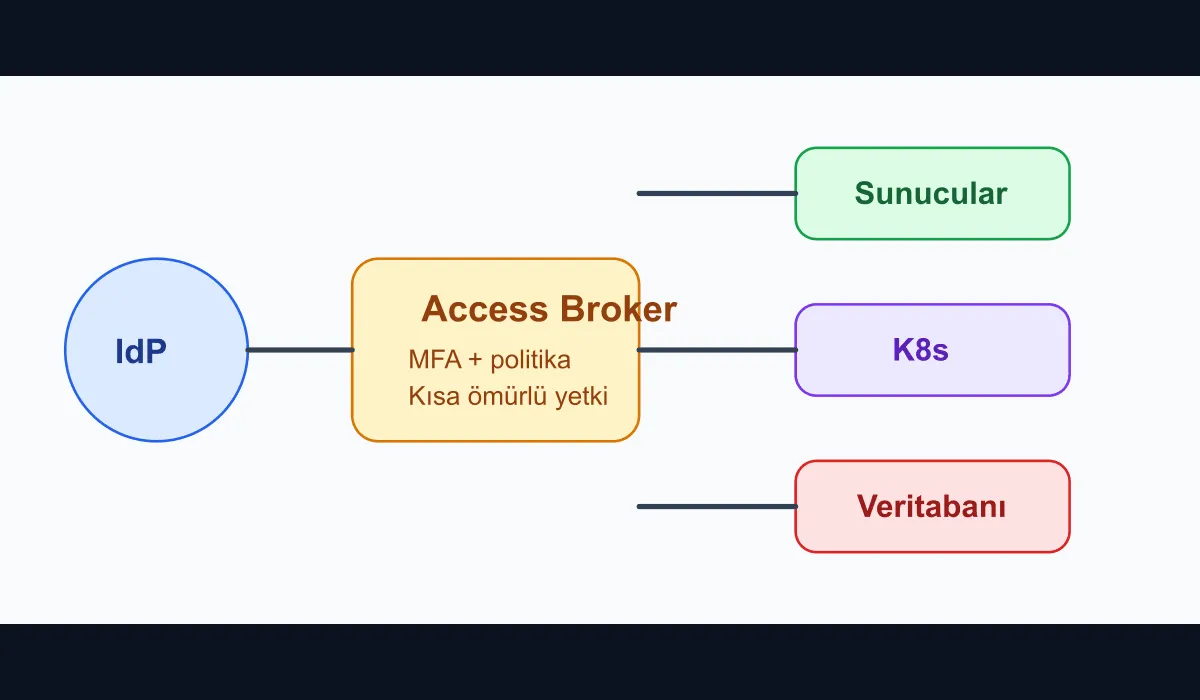
What does ephemeral access mean?
It means that a user or automation receives an access ticket valid only for a specific job, for a specific duration, and on specific targets. In this model:
- Persistent shared passwords or keys are not handed out
- Access is opened through the identity provider and policy engine
- When the session ends, the privilege is revoked too
- The audit and recording trail is created together with the session
The difference here is that access is not permanently open on the network and is not carried via secrets stored on the user side for long periods.
Why is the bastion no longer enough?
Bastion servers still help in some scenarios, but at enterprise scale they introduce the following issues:
- They form a single jump point
- Session records may end up fragmented
- Individual traceability weakens because of shared accounts
- Key rotation and access removal processes become manual
Especially when hybrid cloud, Kubernetes nodes, and ERP-adjacent Linux servers all bind to the same access model, bastion management becomes a separate platform burden in itself.
Reference architecture
Ephemeral management access is typically built with the following components:
- A central identity provider
- An access broker or access proxy
- A policy engine
- Short-lived certificate or token issuance
- A session recording and audit layer
The user logs in with strong authentication, requests access based on role and context information, the broker issues a short-lived identity for the target system, and brokers the session. At the network level, targets are generally not exposed to the public internet; the access broker acts as a controlled gateway.
In which areas does it deliver the fastest value?
This model is especially effective in the following environments:
- Privileged Linux server administration
- Temporary incident response access
- Production database maintenance sessions
- Time-bound access for vendors or external teams
- Limited management needs of ERP operations teams
Granting short-lived access tied to a work order instead of opening a persistent VPN account is much clearer in terms of auditability.
Critical points missed in design
Ephemeral access is not solved by simply installing a new tool. The following questions must be clear from the start:
- Will the emergency access path be different from the normal flow?
- Is the access decision fed by CMDB or asset criticality data?
- Is session recording compliant with data protection policies?
- Is there a different flow for automation accounts versus human access?
If these distinctions are not made, the old bastion practice is carried into the new tools.
Implementation order
For a robust transition, the following sequence can be applied:
- Inventory the existing bastion and admin access
- Move the riskiest production access points to the short-lived model
- Phase out persistent SSH keys gradually
- Connect session records to the SOC and audit pipeline
- Finally, simplify the network access model
When followed in this order, the change produces not only a security policy but also operational ease.
Conclusion
Ephemeral management access in enterprise infrastructure is a broader discipline than a project to remove the bastion. The aim is to base management access on identity, context, and time limits rather than network proximity. When short-lived access tickets, central audit, and a policy-driven decision mechanism work together, both the attack surface shrinks and operations teams work in a more traceable way.