
In enterprise environments, the API gateway is often positioned as little more than a reverse proxy that does routing. Its real value, though, lies in turning technical integration points into a centralized surface for security and governance. Especially when ERP, mobile apps, partner integrations, and internal service traffic all share the same ecosystem, re-implementing identity, rate-limit, and data-protection decisions inside every team is not sustainable.
Why isn’t leaving it in application code enough?
API security is more than verifying a JWT or running a role check. On the enterprise side, these decisions have to be made together:
- Which client is allowed to reach which API family?
- What should the rate limit be for a given consumer?
- How should sensitive fields be masked in logs and responses?
- When should suspicious traffic behavior be cut off?
- How do we trace which request used which contract version?
Letting application teams handle these controls one by one leads, over time, to rule drift. The end state is similar APIs inside the same company exposing different security behavior.
What does the policy-based model propose?
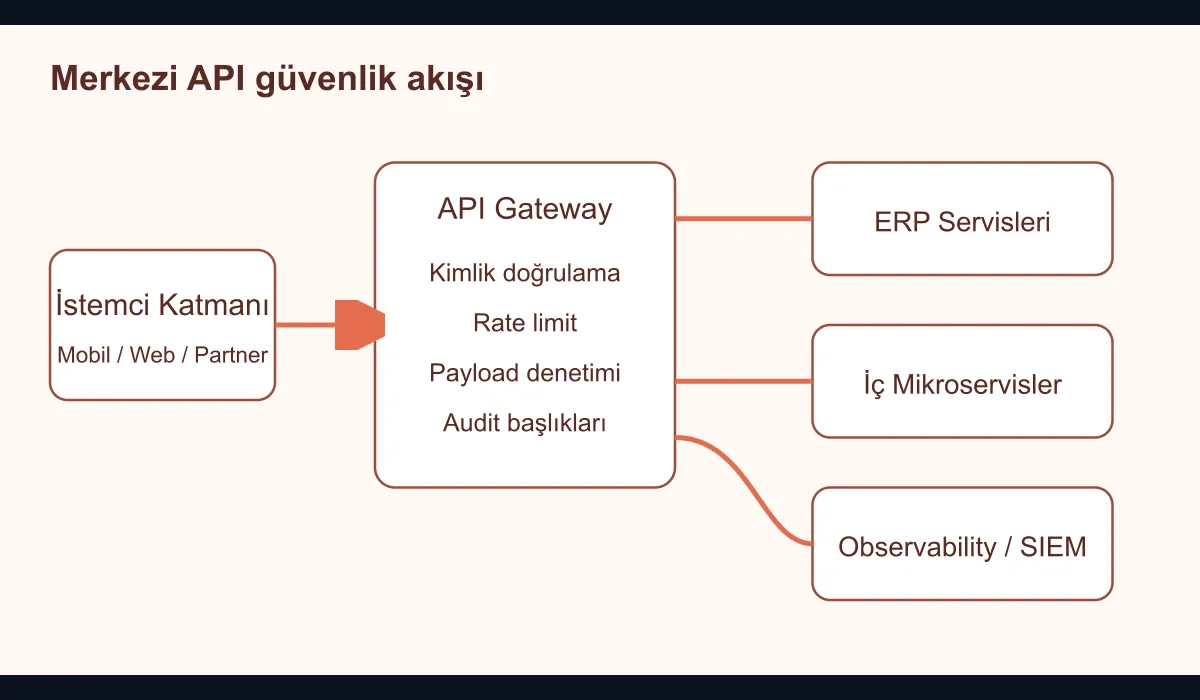
A policy-based approach treats the API gateway as more than a routing layer. In this model, the gateway centrally enforces, during request processing, a clear set of decisions:
- Authentication and client profile
- Authorization and resource-access constraints
- Rate limiting and quotas
- Schema validation and payload filtering
- Audit and telemetry generation
This way, applications can focus on business logic while the lifecycle of security policies is consolidated in a layer that can actually be managed.
Which policies should be defined from day one?
In practice, the highest-value sets are these:
- Internal vs. external client classification
- Token lifetime and scope checks
- Extra verification by IP or network origin
- Tighter rate limits for critical endpoints
- Stripping sensitive headers and fields from logs
- Standardized error codes and trace headers
Why does this matter so much in ERP and enterprise integration?
Enterprise core systems are rarely uniform. SOAP, REST, file transfers, and internal service calls often live side by side. The API gateway delivers three important benefits to this messy surface:
- It creates a controlled entry surface for new consumers.
- It reduces the need to expose legacy services directly to the internet or to a wide internal network.
- It makes request volume and error behavior measurable from a single point.
This is especially impactful for dealer integrations, e-commerce connections, and mobile clients.
Don’t neglect the telemetry side
A good API security model is not just a blocking layer; it is also a learning layer. So these signals must be produced:
- Request volume per client
- Unauthorized access attempts
- Usage distribution by version
- Rate-limit violations
- Latency to the target service
Without this data, policy adjustments tend to be made on intuition. Once the real traffic behavior is visible, both security and performance decisions become much more defensible.
Common design mistakes
There are recurring mistakes I see in enterprise environments:
- Using the API gateway only as an SSL termination point
- Treating internal and external clients with the same trust model
- Defining rate-limit rules with crude global numbers instead of business criticality
- Not putting gateway configurations under version control
- Not feeding gateway events into the central observability stream
These mistakes turn the gateway from a management layer into a brand new single point of failure.
Conclusion
When designed correctly, the enterprise API gateway is not just a traffic-routing component; it is the policy surface where identity, rate limiting, data protection, and audit rules come together. Especially for organizations with heterogeneous integration surfaces, consolidating security into a centralized and observable layer—rather than scattering it across application code—produces a stronger architecture both for operational consistency and for auditability.