
On enterprise platforms, certificate management lives for a long time as an invisible side task. When an application stands up, a wildcard is acquired, loaded into the reverse proxy, renewed by someone when it expires, and life seems to go on as usual. As scale grows, this model quietly collapses. Because a certificate is no longer just the file that turns on HTTPS; it relates directly to service identity, machine trust, environment separation, automation discipline and incident impact. That is why the certificate lifecycle deserves to be treated as a platform architecture topic in its own right.
Why does the problem grow?
Because the number of certificates increases, while the ownership model does not mature at the same rate. After a while, the picture in the organization looks like this:
- Which certificate belongs to which service is not clearly known.
- Whether the renewal flow is manual or automated varies.
- Where private keys are stored is inconsistent.
- Services using mTLS and public edge certificates are managed with the same approach.
Under these conditions, a certificate expiry is not just an operational mistake; it is a sign of architectural shortcoming.
What stages does the lifecycle consist of?
The framework I use in practice has six stages:
- Request and policy decision
- Issuance and signing
- Distribution and binding
- Rotation and renewal
- Revocation and emergency response
- Inventory and audit
Most organizations do the first three steps in some way; but because the last three are missing, certificate management does not become reliable.
The same certificate model does not work everywhere
The edge layer, internal service identity, human access and device certificates carry different needs. Therefore, instead of a single PKI narrative, separation by usage class is required:
- External-facing TLS certificates
- Short-lived mTLS certificates for internal services
- User or device certificates for management access
- Machine identity for batch or integration workloads
When these classes are not separated, the renewal cadence, trust boundary and revocation impact get tangled.
How should the architectural backbone be built?
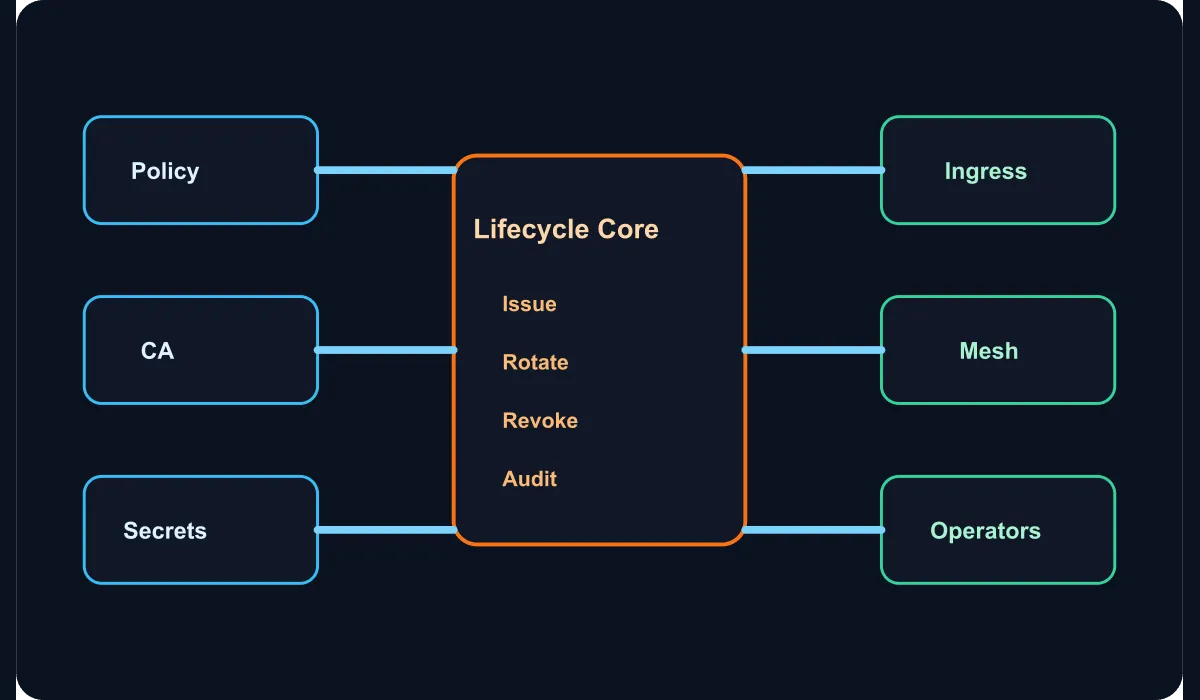
A healthy model contains the following pieces:
- A policy engine or approval rule
- An enterprise CA or trusted signing authority
- A secret vault or key-protection layer
- A runtime distribution mechanism
- An inventory and event log
The critical decision here is whether you manage certificate issuance like a CI job or like a platform service. I find the second approach more correct. Because the certificate lifecycle includes events independent of application deployment as well.
The most common mistakes
I see four recurring mistakes on enterprise teams:
- Trusting in the same wildcard usage across environments
- Leaving certificate renewal to cron success
- Mapping the certificate owner to a person rather than a team
- Never testing the revocation scenario
These mistakes are invisible on normal days; they cost dearly the moment of the first security incident, CA migration, or misdistribution.
Measurable success signals
You can tell the certificate architecture is maturing from these signals:
- The share of off-inventory certificates drops.
- The need for manual renewals decreases.
- Distribution of mTLS or service identity becomes simpler for application teams.
- Approaching expirations are resolved before turning into an incident.
- The redistribution time after an emergency revocation becomes measurable.
These metrics show the certificate has truly turned into a platform capability.
The enterprise communication dimension
The certificate topic looks technical; but its impact is enterprise-wide. A single certificate renewal window can simultaneously affect API consumers, mobile clients, third-party integrations and internal operations teams. That is why change communication is also part of the lifecycle architecture. How far in advance an announcement is needed for which certificate class, which teams could be affected and what the rollback plan is must be defined upfront.
Conclusion
On enterprise platforms, the certificate lifecycle architecture is not a back-office task for the security team. It is the shared intersection of platform engineering, automation, service identity and enterprise continuity. When you manage a certificate not as a file but as an asset that has a lifecycle, you both reduce outage risk and define the platform’s trust boundaries more cleanly. As scale grows, the right question stops being “who is renewing the certificate” and becomes “which principle is the certificate architecture living by.”