
In enterprise environments, SIEM cost often blows up not from licensing but from uncontrolled growth of telemetry traffic. When applications, infrastructure services, firewalls, endpoint devices, and cloud services flood the same pool with unmeasured data, two problems arise at once: critical events become hard to find, and the operations team continually defends a budget for carrying unnecessary data. That is why a sampling strategy is not just a cost reduction technique; it is an architectural decision that protects security visibility.
Why is sampling misunderstood?
In most teams, sampling is treated as “send fewer logs”. This approach is dangerous because it does not classify which events are needed for security, which for operations, and which for forensic analysis. The result is either critical data is lost or data that truly serves no purpose continues to be retained.
The right approach is to first classify the telemetry stream:
- Events mandatory for security
- Operational error and capacity events
- High-volume but low-value debug or access events
- Records subject to legal retention
Making a sampling decision without this distinction means blinding the data architecture.
Which data should never be sampled?
Not every dataset has the same value. The following signals usually require full retention:
- Authentication and authorization events
- Privilege escalations
- Policy violation and access denial records
- Critical infrastructure changes
- Administrative actions on production ERP or finance systems
In particular, failed sign-in attempts, role changes, and security policy decisions later become foundational data in event correlation. Sampling them breaks the incident investigation chain.
Where can aggressive sampling be applied?
The largest volume usually comes from access logs, health checks, and repeating success records. Contextual sampling can be applied here:
- 1 to 5 percent of
200access logs from healthy services are kept - Repeating probe requests from the same user agent are grouped
- Kubernetes readiness or liveness calls are routed to a separate stream
- Data already retained at the CDN or WAF is not stored again at the application layer
In this method, the goal is not to lose data, but to reduce the number of copies of the same information.
Architectural decision points
When building an enterprise SIEM sampling strategy, four design questions become critical.
1. Will the decision be made before ingestion or after?
Pre-ingestion sampling provides a cost advantage, but a wrong decision cannot be reversed. Post-ingestion decisions are more flexible, but they require additional storage for the raw data layer. In highly regulated structures, a short-lived raw data buffer is often safer.
2. Who will own the rules?
Sampling rules should not be managed solely by the SOC team’s decision. If network, platform, application, and compliance sides do not jointly decide, critical use cases will be missed.
3. How will event priority be encoded?
If sources produce a telemetry priority field such as critical, important, routine, then routing and retention policies become simpler.
4. How will feedback be collected?
If the event types SOC analysts most frequently search for but cannot find are not reported regularly, the sampling policy gradually goes blind.
A workable reference model
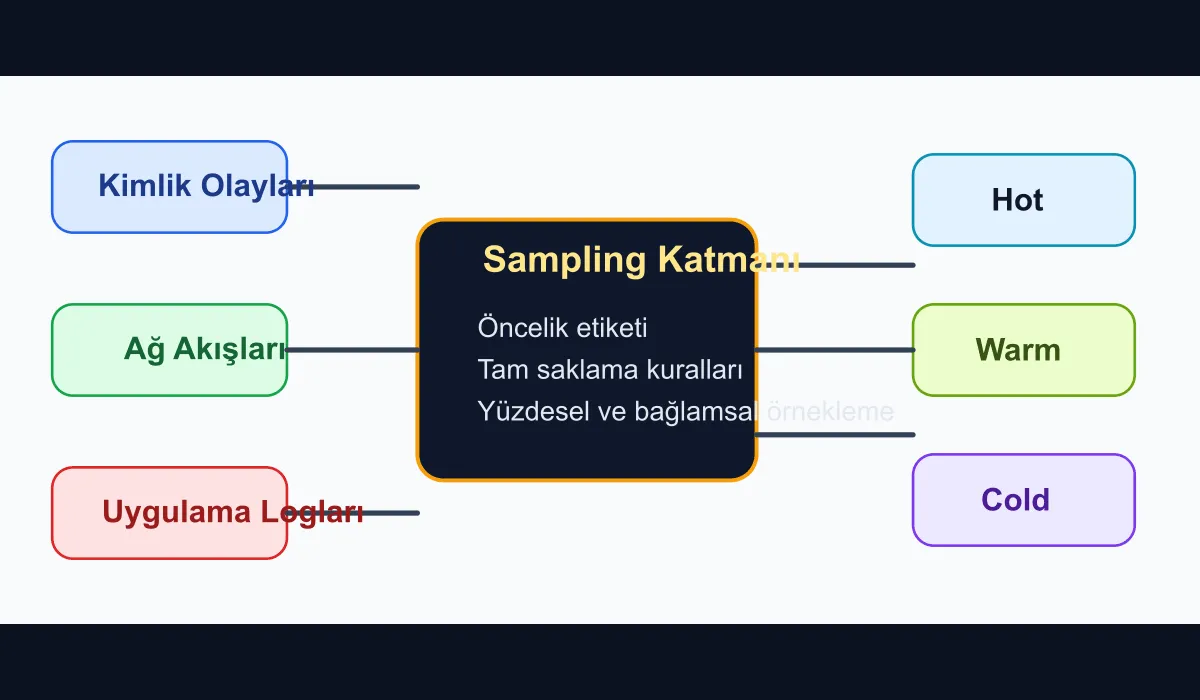
A model that works well in the field is generally three-tiered:
hot: Data needed for identity, security control, and incident response. Full retention.warm: Data needed for operations and capacity analysis. Selective sampling.cold: Raw or compliance-oriented archive. Cheap storage, slow access.
In this model, the central pipeline rather than the telemetry producer decides which data goes where. This way, application teams are not forced to write a different log policy for each service.
Special case for ERP and enterprise core systems
On the ERP side, low-volume but high-impact events occur. Privilege assignments, batch job triggers, critical table export operations, or unexpected access by integration users must always be retained in full. The areas to be sampled here are usually technical success logs, not records of high business impact.
To make this distinction, architects who know the business workflow and security teams need to work on the same table. Otherwise, ERP telemetry is either retained more than necessary or the most important events are lost during simplification.
Conclusion
A sampling strategy for enterprise SIEM is not a log reduction project but a visibility design. When it is clarified which signal serves incident response, which serves capacity management, and which has only archival value, both cost and analyst productivity improve. The most correct starting point is not the question of “which logs should we cut” but the question of “which decisions are we making based on this data”.