
A common misconception in backup strategies is to assume that recovery confidence automatically rises as the number of copies grows. Yet in ransomware, faulty authorization, or erroneous automation scenarios, the truly critical question is this: is the area you will return to really separate enough from production and from the management chain? An isolated recovery zone moves the backup architecture beyond a storage problem and turns it into a reliable rollback scenario.
Why is immutable backup alone not enough?
Immutable snapshots or WORM storage are very valuable; however, they are not sufficient by themselves. Because the following risks remain during recovery:
- The same identity domain may have been compromised
- The management network may not be trustworthy
- The recovery automation may be faulty or tampered with
- The recovery environment may have never been tested
The isolated recovery zone separates the management and access boundaries to mitigate these risks.
Core architectural approach
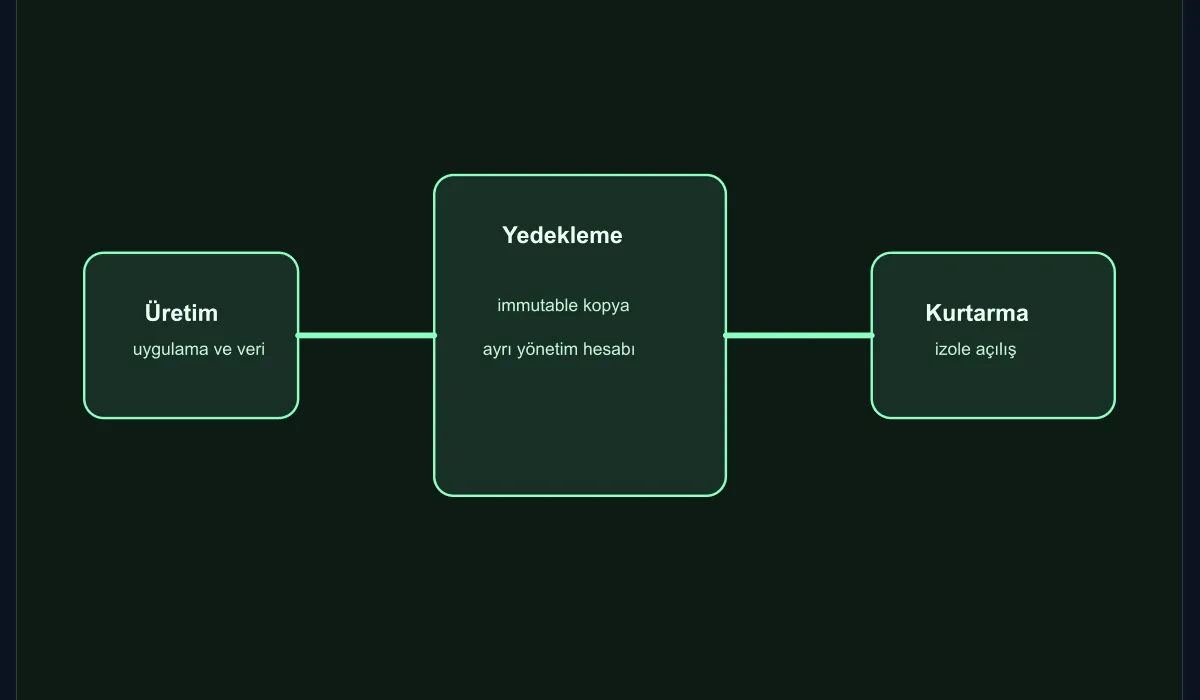
In a healthy model, three separate areas are defined:
- Production area: running workloads
- Backup area: the layer where protected copies are kept
- Recovery area: an isolated zone brought up in a controlled manner when needed
These areas may live within the same physical organization; however, the network, identity, management accounts, and access processes should be separated as much as possible.
Which separations are critical?
- A separate management account or tenant
- Access keys and MFA policy that differ from production
- Limited directional network flow
- A temporary and recorded access model during recovery
- Clean data samples or a masking approach for testing
Why is it even more important for ERP and enterprise data?
Because ERP, finance, and operations data are critical not only technically but also for business continuity, the following expectations arise during rollback:
- It must be possible to return to the correct point in time
- Data integrity must be verifiable
- Dependent services must come up together
- Test and real recovery paths should be similar
The isolated recovery zone does more than read backups to meet these expectations; it provides a controlled restart area.
What needs to be tested regularly?
The value of a recovery zone comes not from the architecture on paper but from repeated drills. The following scenarios in particular should be exercised periodically:
- Accessing the system with a separate identity
- Bringing things up from the last solid recovery point
- Network segment and DNS behavior
- Consistency between the application and the data layer
- The minimum operational level accepted by business units
Without these tests, the phrase “we have backups” provides no real rollback guarantee.
Conclusion
The isolated recovery zone in backup infrastructure is the often-neglected piece of enterprise resilience. Just as backups being immutable matters; being able to restore them in a safe, separate, and tested area is just as critical. Especially in environments with ransomware risk, ERP dependencies, and strict audit requirements, the recovery zone needs to be designed as a separate architectural layer.