
Defining server standards in code on its own is not enough; you also need to regularly verify that live systems actually match those definitions. Drift detection makes the differences caused by manual interventions, emergency fixes, or forgotten package changes visible. For this work, Ansible is highly effective not just as a deployment tool but also as an audit tool.
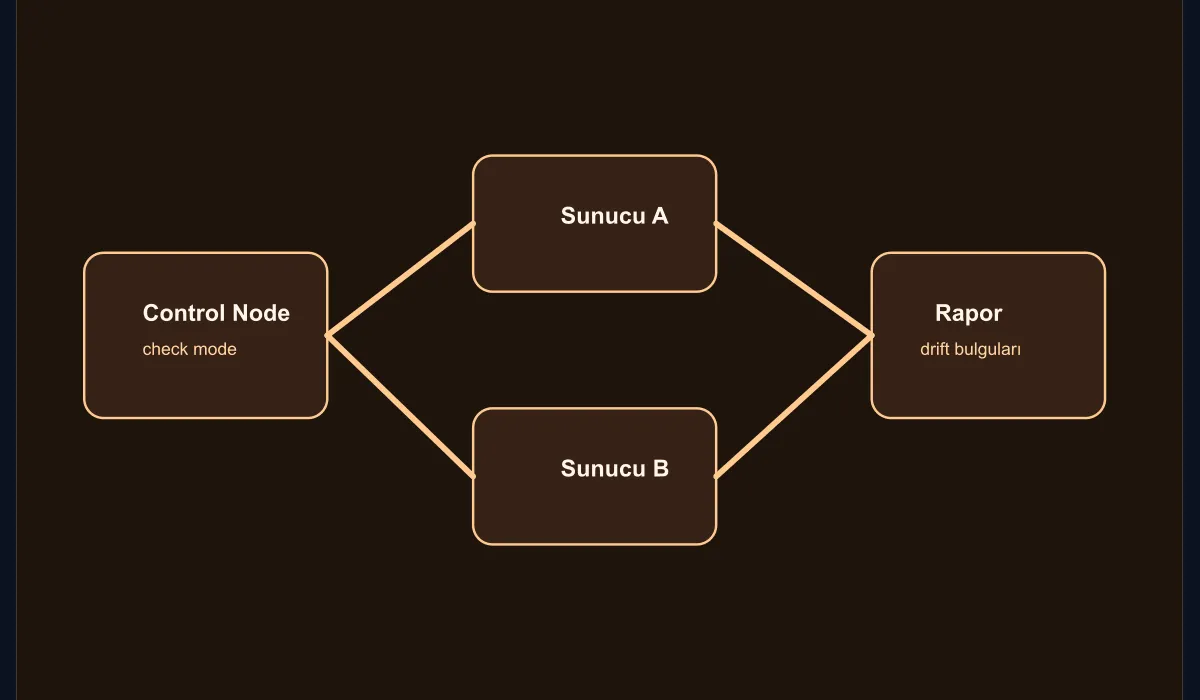
What exactly is drift?
It is when a server deviates from its expected state. This deviation can show up in:
- The list of installed packages
- Configuration file contents
- Running service status
- Open ports and listening processes
- Authorized user or group memberships
These differences may seem minor, yet they create serious issues for security, operations, and auditability.
Approach: observe before you enforce
In the first phase, the goal is not to auto-correct drift but to make it visible. For this, --check mode, changed_when, failed_when, and custom verification tasks can be used together.
A simple example:
- name: SSH ayarini denetle
  ansible.builtin.lineinfile:
    path: /etc/ssh/sshd_config
    regexp: '^PasswordAuthentication'
    line: 'PasswordAuthentication no'
  check_mode: true
  register: ssh_policy

- name: Sapma varsa raporla
  ansible.builtin.debug:
    msg: "SSH politikasi beklenen durumdan sapmis"
  when: ssh_policy.changed
This pattern lets you see the difference without mutating the live server.
The most useful audit areas
To start, the following control sets generate high value:
- Package and repository standards
- SSH and basic hardening settings
- Whether security agents are actually running
- Time synchronization and log shipping
- The list of authorized users
These areas yield rapid security feedback, especially on servers with administrative access.
A sample reporting approach
Rather than leaving the Ansible output only in the terminal, turning it into a JSON or Markdown report is more practical. The simple approach:
- Group inventory by team or environment
- Collect
registeroutput for each check - Compile the results into a single report file
- Surface critical deviations through CI or cron
This way drift detection becomes continuous control instead of a one-off experiment.
When should auto-remediation be added?
Observe first, then understand the patterns. If the same deviations keep recurring, ask two questions:
- Is this drift truly an undesired manual intervention?
- Or is the standard definition itself out of date?
Adding auto-remediation before that answer is clear can amplify false positives. The healthy order is: visibility, classification, approved remediation, and only then full automation.
Conclusion
Server configuration drift detection with Ansible turns infrastructure standards into living controls. Especially for Linux servers, bastion systems, and enterprise service nodes, regular drift auditing surfaces security gaps, undocumented changes, and operational risk early. Discipline in infrastructure is not just about applying changes; it is also about continuously measuring deviation.