
In distributed systems, time drift is often an invisible but expensive problem. Log correlation breaks, certificate validation fails in unexpected ways, replication lag is misread, and incident analysis drags on. Even if you already use Chrony for clock synchronization on Linux servers, the real value emerges only when you can monitor that behavior continuously.
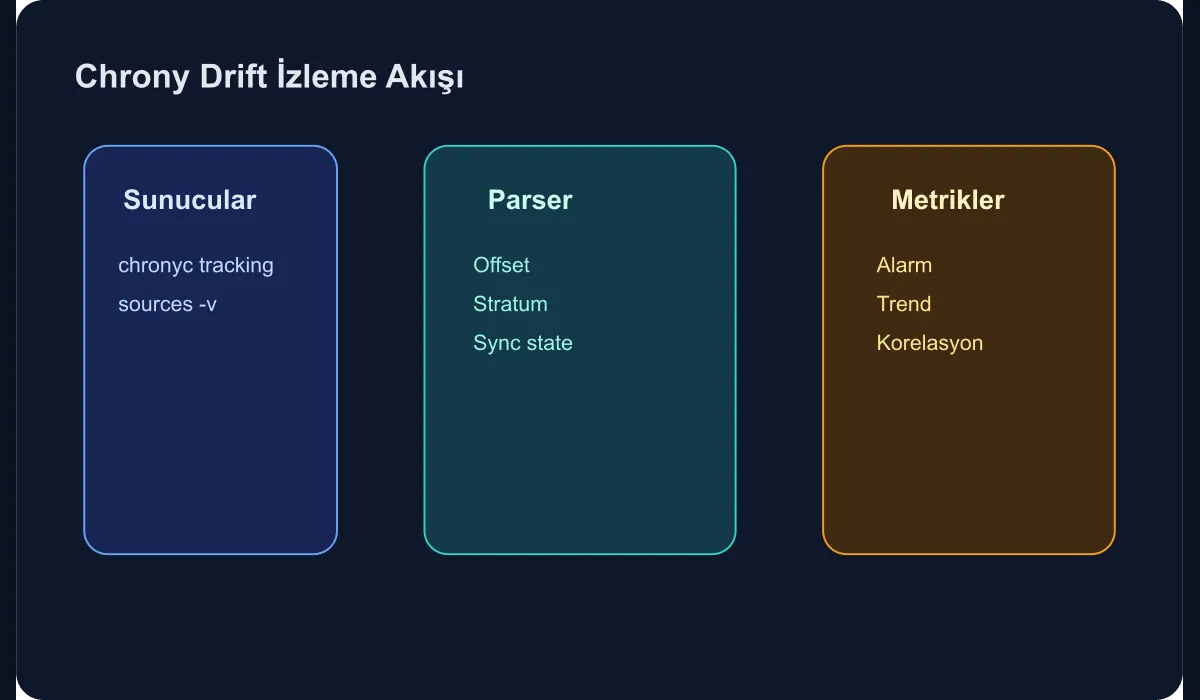
What should we monitor?
The most useful signals on the Chrony side are these:
- reference source state,
- the latest offset value,
- root delay and root dispersion,
- sync state,
- source change frequency.
When these data points come together, you can tell whether the issue is really in the network, in an upstream NTP source, or on a single server.
Quick check commands
To make Chrony’s state visible by hand at the start, these commands are enough:
chronyc tracking
chronyc sources -v
chronyc sourcestats -v
In particular, the Last offset and RMS offset fields in the tracking output are very useful in day-to-day operations.
A logic for automated monitoring
A simple and effective approach is to parse this output periodically and ship it to a central metrics system. For example:
#!/usr/bin/env bash
set -euo pipefail

offset=$(chronyc tracking | awk -F: '/Last offset/ {gsub(/seconds/,"",$2); gsub(/ /,"",$2); print $2}')
stratum=$(chronyc tracking | awk -F: '/Stratum/ {gsub(/ /,"",$2); print $2}')

echo "chrony_last_offset_seconds ${offset}"
echo "chrony_stratum ${stratum}"
Output like this can be picked up via the node exporter textfile collector or a custom agent.
Where is it especially critical?
Time drift monitoring delivers high value in environments such as:
- enterprise networks spanning multiple data centers,
- ERP and financial transaction systems,
- platforms with heavy certificate and authentication usage,
- SIEM architectures that rely on log correlation.
In these environments, even small clock deviations directly degrade observability quality.
Conclusion
Monitoring time drift on servers with Chrony moves you to a more mature operational stance than just saying “NTP is running.” How accurate the clock is often determines how legible the system is. For that reason, time drift should be treated not as an invisible infrastructure topic, but as an active observability signal.