
As platform teams grow, the same problem keeps coming back: as shared services multiply, you gain speed but also raise the risk of central dependency. At that breaking point, the question to ask is not “should we build more platforms?” but rather which pieces are genuinely a control plane. Cleanly decoupling the control plane from the product lifecycle is one of the most critical architectural skills in enterprise platforms.
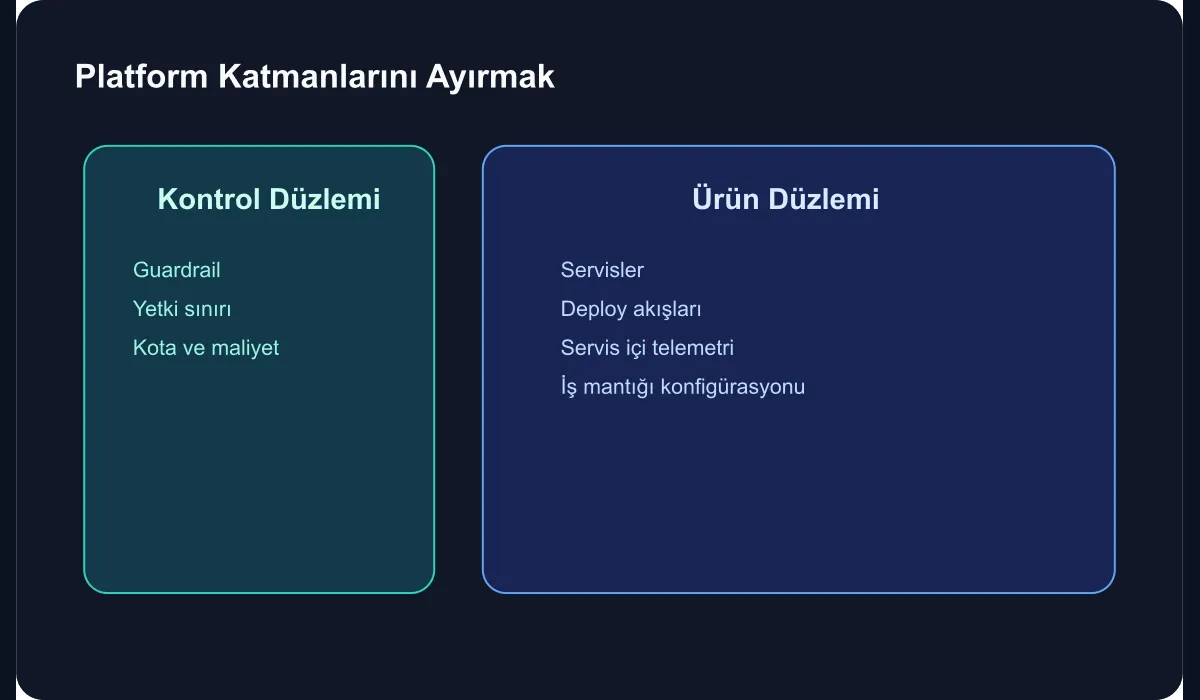
Why should the control plane be considered separately?
Because under the label of “platform” two very different things end up in the same bucket:
- the shared runtimes and services that teams consume,
- the control logic that determines how those services are governed.
When you mix the two, every change has to go through the platform team. Over time that produces not self-service, but a hidden ticket system.
What belongs to the control plane?
At enterprise scale, I find it useful to view these pieces as the control plane:
- Policies and guardrails
- Identity and authorization boundaries
- The minimum observability contract
- Environment promotion and rollback rules
- Cost and capacity quotas
Their common trait is that they don’t drive product behavior directly — they define the boundary within which product behavior happens.
What should product teams own?
In a healthy split, product teams own:
- the service lifecycle,
- telemetry close to business logic,
- rollout timing,
- in-service configuration choices.
The platform team builds the shared playing field that governs these and the protective mechanisms around it. What gets centralized this way is operational culture, not the daily workflow.
What is the most common mistake?
The most frequent mistake as a platform matures is turning every useful component into a mandatory central concern. The result: product teams cannot make their own decisions, and the platform team cannot keep up with every detail. The model looks like a standard in the short term and produces a slow-moving queue in the medium term.
The right boundary can be tested with this question: without this component, can a product team move forward safely, or is the shared usage simply convenient? If it leans toward the first, it’s a control-plane candidate; if toward the second, it can be a platform product but should not be a mandatory hub.
Conclusion
A control-plane decoupling strategy in enterprise platforms is not an abstract architectural debate. This separation determines whether the platform team becomes a bottleneck or a multiplier. Structures that centralize decisions, policy, and security while keeping service behavior with the product team produce platforms that are both more scalable and more teachable.