
As identity, logging, network, and automation layers grow inside enterprise cloud architectures, a critical question surfaces: how cleanly have we actually separated the management plane from production resources? Many organizations assume opening a “management account” is enough; yet if that account shares the same CI keys, the same IAM roles, and the same network egress rules, the separation remains largely theoretical. A safer approach is to design a controlled and hardened quarantine account dedicated to the management plane.
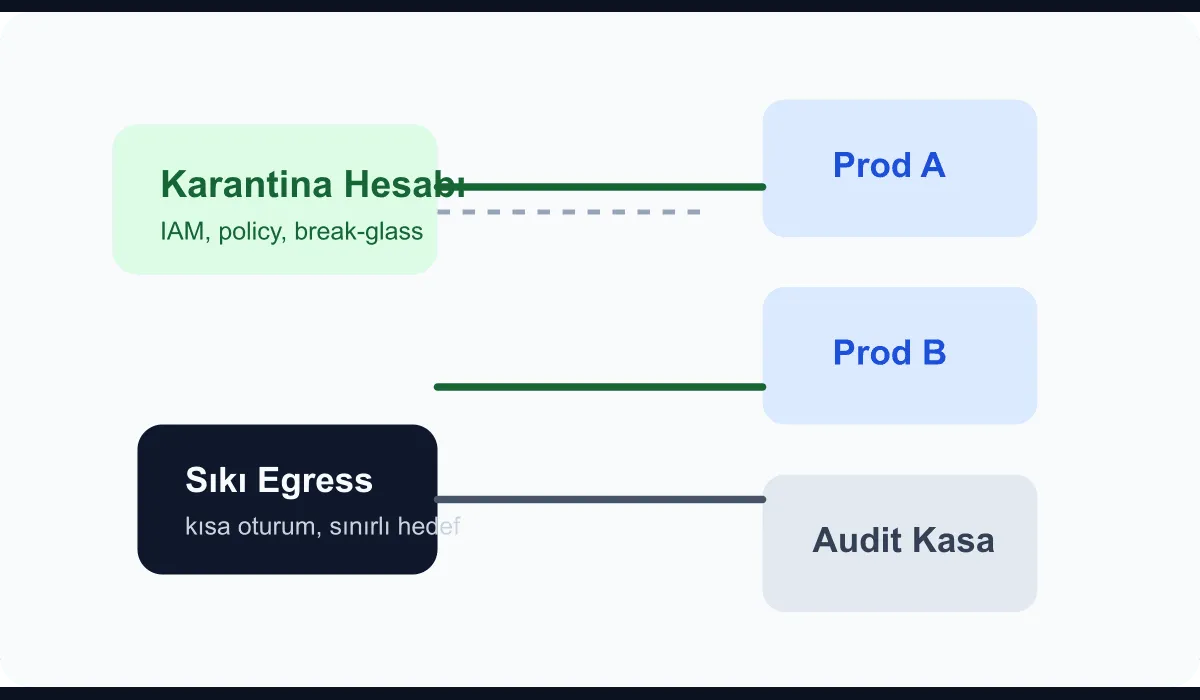
What does a quarantine account aim for?
The goal is not to centralize management services; it is to shrink their blast radius. The following components are particularly strong candidates for this account:
- IAM automation
- Centralized audit logs
- Policy as code runners
- Security scanning orchestration
- Break-glass and emergency access vaults
When these components run directly inside production accounts, a single key leak or misconfigured role chain can result in losing control over the entire platform.
Why might an existing shared services account fall short?
Because shared services accounts usually grow around convenience. CI, artifact repositories, observability agents, and platform services all end up in the same place. That approach can speed up operations; however, it is problematic from a trust-boundary perspective. A quarantine account, by contrast, is built around the opposite principle:
- Less human access
- Shorter-lived sessions
- Narrower network egress
- Stronger audit records
- Slower but more controlled change flow
In other words, the goal is not comfort — it is to establish a secure control point.
What are the core design decisions?
In this architecture I see four decisions as critical:
- One-way management flow: The management account can issue commands to production accounts; the reverse direction must remain limited.
- Separate identity path: Human access and machine access must not be chained to the same role.
- Regional record protection: Audit logs must not be tied to a single region only.
- Emergency exception: Break-glass access must live in a vault separate from the regular flow.
Without these decisions, every “management account” you spin up — however secure it appears — turns into yet another shared account in practice.
How should the network and access boundary be set up?
The internet egress, artifact access, and rules for talking to production accounts inside the quarantine account should be as narrow as possible. The following controls are especially useful:
- Only approved egress destinations
- A separate DNS resolution policy
- Short-lived access sessions for management tools
- Logged automation flow instead of interactive access
- Mandatory justification or ticket context for every role
This approach slows operations a little, but it dramatically reduces the impact of a mistake spreading across the entire organization.
What is the cost for platform teams?
Every secure architecture comes with an operational cost. The quarantine account is no exception. It demands more role separation, more approval flow, and tighter network rules. Yet that cost makes sense — especially in multi-account environments or under regulatory pressure. Because compromise of the management plane produces far broader impact than the breach of a single application account.
What matters here is keeping the quarantine account as a limited zone where only critical control functions live, rather than turning it into yet another central hub that absorbs everything.
Conclusion
A quarantine account for the management plane in enterprise cloud is not extra rigidity for the security team; it is a way to limit platform risk at the engineering level. When management services run with separate identity, separate network, and separate audit assumptions, mistakes or leaks that originate in production accounts cannot directly hop into control of the entire organization. Real maturity in modern cloud architecture sometimes comes not from adding more services, but from running the most critical ones with fewer trust assumptions.