
In the enterprise cloud, cost discipline in most teams begins with the end-of-month report. The bill grows, a dashboard opens, a few large resources are spotted, and then a savings campaign starts. This approach is always late. Because most of the cost arises not from malicious spending but from loose defaults. The FinOps guardrail layer should be treated not as a reporting function for a team but as an architectural control surface that shapes behavior at the moment of provisioning.
Why is a guardrail layer needed?
Because most of the cost comes not from individually expensive resources but from small violations that accumulate over time. Untagged resources, unbounded retention, forgotten test environments, the wrong instance family, and unnecessary data egress all quietly inflate the bill.
That is why the FinOps approach must not be limited to visibility. The following rules need to be embedded at the provisioning level:
- Mandatory tagging and ownership information
- Lifetime limits per environment
- An allow-list for region and service type
- Default retention and snapshot policy
- Budget thresholds for egress and data copy
Without these rules, teams repeat the same mistakes with the best of intentions.
At which layer should it be enforced?
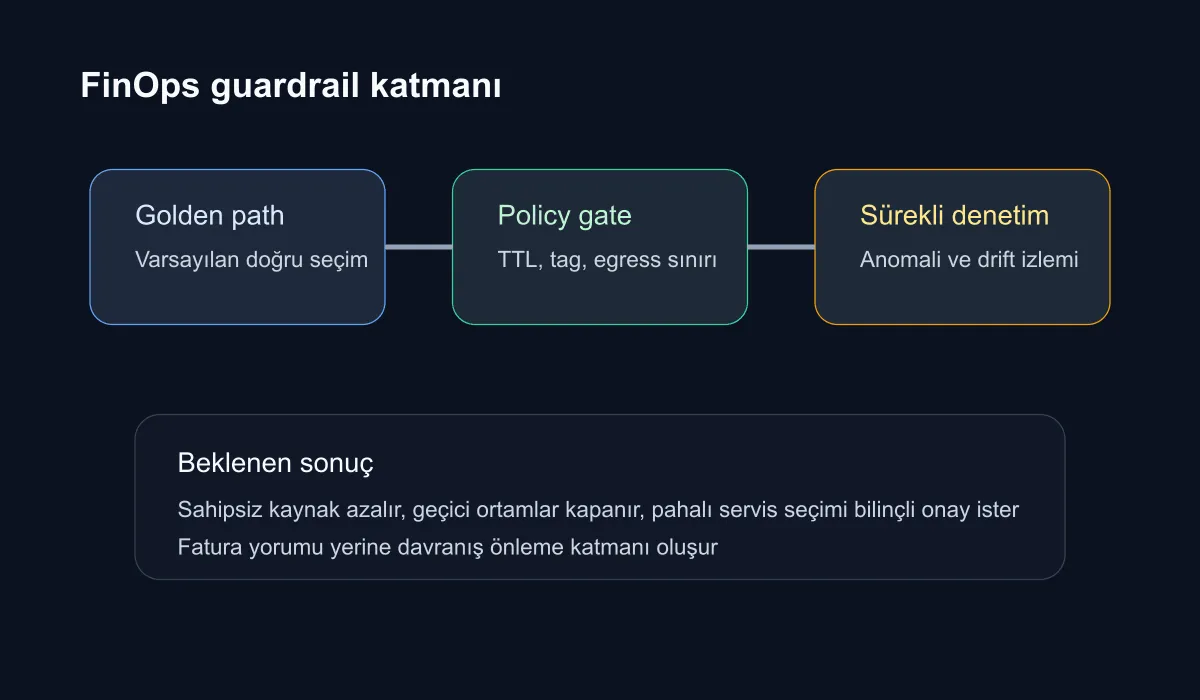
I find it useful to think of the guardrail layer at three levels:
- Self-service templates and the golden path
- IaC policy checks
- Continuous cost-anomaly auditing for running environments
If only the third layer exists, the organization comments after the fact. If only the first layer exists, exceptions multiply. When all three work together, cost control becomes both preventive and corrective.
Why do technical teams sometimes resist?
Because the cost constraint is often presented as an external business pressure. The right framing, however, is this: a FinOps guardrail is not a slow-moving approval workflow but a safety layer that automatically stops repeating wrong choices.
In good examples the developer experience looks like this:
- The right instance family already arrives as the default
- Temporary environments terminate themselves
- Retention class is preassigned for storage like S3
- High egress or expensive disk types require deliberate approval
This model moves cost from a manual warning into a system behavior.
How does it combine with observability and security?
In enterprise structures cost rules don’t live alone. A retention limit may conflict with a security record-keeping need; an egress limit may affect the replication strategy. That is why the FinOps guardrail set must be written in the shared language of these teams:
- Platform and cloud architecture
- Security and compliance
- Operations and observability
- Product or workload owners
Without that partnership, cost discipline either becomes too rigid or stays entirely ineffective.
Which metrics are actually meaningful?
I find measuring guardrail success only by total bill weak. Better signals are these:
- Orphan-resource ratio
- Number of temporary environments that auto-terminate
- Rate of high-cost changes blocked due to policy
- Cost trend per unit workload
- Ratio of violations prevented up front rather than cleaned up afterward
This dashboard makes it clear whether the control mechanism is doing reporting or behavior shaping.
Conclusion
A FinOps guardrail layer for the enterprise cloud takes budget defense out of the monthly slide deck and embeds it into the platform architecture. When tagging, lifecycle, service selection, and data movement rules run at the moment of provisioning, cost discipline produces less debate and more default behavior. Real maturity is not about panicking when you see the invoice; it is about being able to block the expensive behavior before it forms.