
In server or Kubernetes security many teams focus only on access control and image scanning. These are necessary; yet attacks or misuse happen at runtime. Operations can only respond meaningfully to an unexpected shell, a privileged process, sensitive file access, or suspicious network behavior from inside a container if those become visible at the moment they occur. Falco is exactly the right tool here for generating runtime security signal.
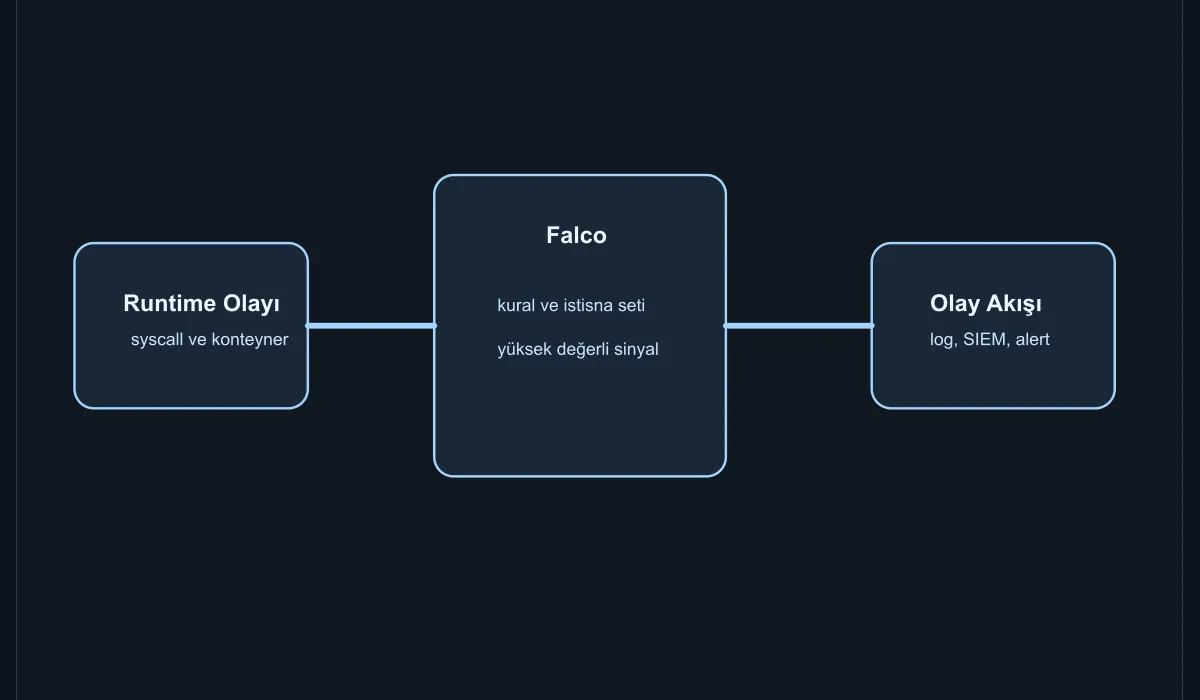
What does Falco watch?
Through system calls and runtime events, Falco helps detect behavior such as:
- Unexpected shell execution
- Unauthorized file reads or writes
- Use of privileged containers
- Host namespace access
- Suspicious network connections
The aim is not antivirus-like signature hunting; it is making operationally relevant security behavior that deviates from normal visible.
Where do you place it?
Falco delivers value in two common scenarios:
- Directly at host level on Linux servers
- As a DaemonSet on Kubernetes clusters
On the Kubernetes side, by running a sensor on every node you can monitor container behavior with a centralized rule set.
A sample Helm install:
helm repo add falcosecurity https://falcosecurity.github.io/charts
helm upgrade --install falco falcosecurity/falco \
  --namespace falco --create-namespace \
  --set falco.grpc.enabled=true
What matters as much as installation is tuning the rules to your environment.
Which rules are valuable from day one?
A few high-signal classes to start with:
- A shell opening inside a production container
- Write attempts into sensitive directories
- Use of privileged containers or hostPath
- Package manager being executed
- Unexpected egress to administrative networks
Even when they do not directly trigger incident response, these rules significantly raise security visibility.
Where should alerts go?
Leaving Falco output only in pod logs is insufficient. A better model:
- Falco events are sent to the central log pipeline
- Critical events route to Alertmanager or an incident management system
- Rule hits are tracked on a dashboard by team and environment
- When needed, the event is forwarded to a SIEM or ticketing system
This way Falco becomes part of the observability and incident process, not a stand-alone sensor.
How do you reduce false positives?
The most critical topic in runtime security tooling is context. To reduce noise:
- Define environment-specific exceptions explicitly
- Separate development and production rule sets
- Add silencing for expected maintenance windows
- Use container image, namespace, and service ownership labels
This approach makes the security signal operationally consumable.
Conclusion
Runtime security observation with Falco makes systems observable not just for how they were installed but for how they behave at runtime. Especially for Linux servers, Kubernetes platforms, and high-privilege services, Falco is a practical layer that closes the gap between security and observability. With the right rule set and the right alerting flow, you can catch hard-to-spot anomalous behavior at an early stage.