
The most common breakdown in log platforms doesn’t happen on the ingestion side; it happens at the retention decision. Holding every log line for the same duration, on the same storage tier, with the same query expectations is a fast way to burn money. A tiered retention approach with Grafana Loki lets you classify log value by business impact and keep total cost under control without ruining the hot query experience.
Why is a single retention policy weak?
In enterprise environments, application logs, audit records, security events, and infrastructure debug output don’t share the same life cycle. Even so, the typical pattern is to manage every stream with a single retention_period. The result is either an unnecessarily expensive search layer or critical records being deleted far too early.
A solid model separates logs not by technical source but by usage intent:
- Day-to-day operational queries
- Short-term post-incident investigation
- Compliance and audit retention
- Low-value debug or transient noise
That separation also helps you manage Loki’s storage and indexing behavior more deliberately.
A tiered retention model
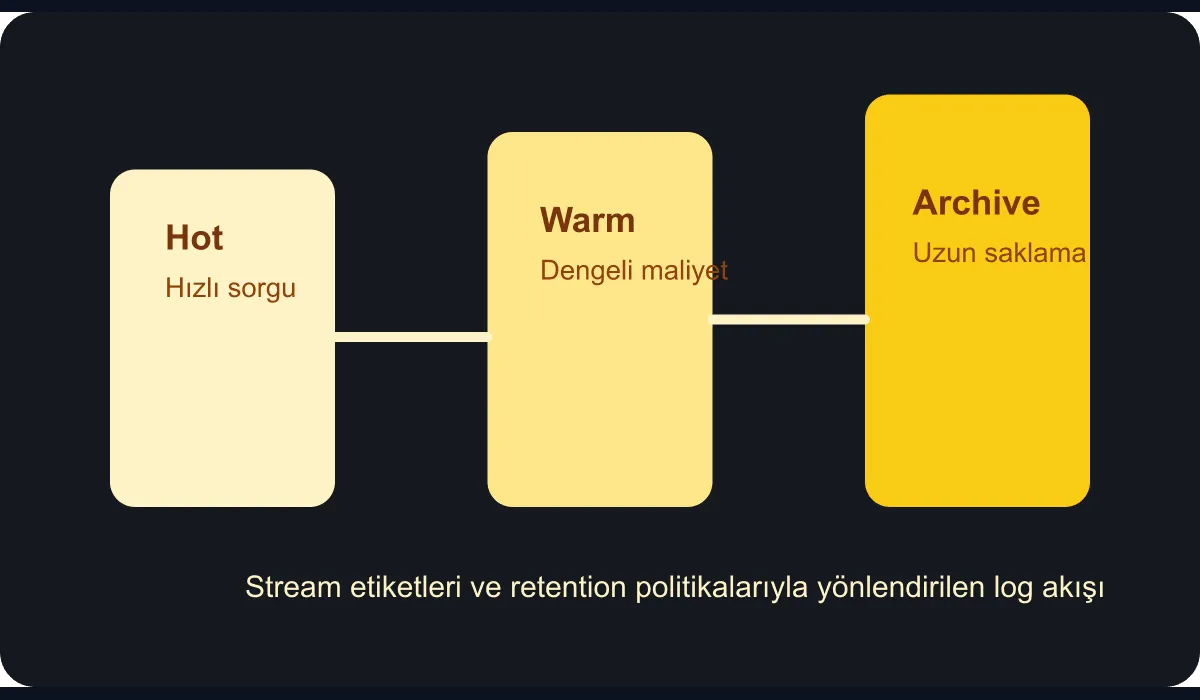
In practice, three tiers work well:
- Hot tier: Logs queried most often, requiring fast access
- Warm tier: Logs used less frequently but still meant to be reachable
- Archive tier: Low-cost storage for compliance or backward-looking review
When using Loki, you can design this separation alongside tenants, stream labels, or object storage policies. The goal isn’t only the deletion timeline; it’s making it explicit which data is held against which query expectation.
Label strategy decides retention success
Retention decisions on the Loki side are often considered independently of the label model. That mistake is expensive. If streams aren’t labelled correctly, you can’t isolate low-value logs and query cost rises.
These labels in particular pull their weight:
log_class:hot,warm,archiveteam: owning teamservice_tier: critical, standard, low prioritycompliance_scope: audit or regulation scope
These fields lift the retention decision out of a technical storage setting and into a governance concern.
Sample approach
A sample mental model for stream selection and retention on Loki:
limits_config:
  retention_period: 168h
  retention_stream:
    - selector: '{log_class="hot"}'
      priority: 1
      period: 168h
    - selector: '{log_class="warm"}'
      priority: 2
      period: 720h
    - selector: '{log_class="archive"}'
      priority: 3
      period: 2160h
This structure isn’t enough on its own, but it does clarify the tier logic. If storage policies are mapped accordingly, you reach a healthier balance between query temperature and retention cost.
Operational validation
Once the retention strategy is live, run these checks:
- Are log streams actually landing in the right class?
- During an incident, do the streams you need stay in the hot tier?
- Are audit queries kept reachable yet not expensive in the archive?
- Are noisy services unnecessarily filling the hot tier?
Without these checks, a retention policy that looks good on paper loses value because of misclassification.
A frequent mistake: keeping everything under the banner of compliance
Enterprise teams sometimes want to keep every log forever, “just in case.” That approach creates two problems. First, costs balloon. Second, the truly important signals get buried inside low-value noise. Separating logs that genuinely need compliance retention by their technical and legal context relieves the rest of the platform from unnecessary load.
A better approach is to write the retention requirement against the data class and assign clear ownership for it.
Conclusion
Tiered log retention with Grafana Loki isn’t only a storage optimization; it’s an architectural decision that clarifies what your log platform exists for. Separating hot, warm, and archive tiers by business impact improves the query experience and makes observability cost more defensible. A strong log platform isn’t the one that retains the most data; it’s the one that retains the right data with the right lifespan.