
When managing secrets inside Kubernetes, the most common mistake is keeping application secrets directly in manifests or CI variables. This model is tolerable in small environments; but as the number of environments, teams, and the security bar grow, it becomes unsustainable. The External Secrets approach solves this problem by establishing a controlled synchronization layer between the central secret vault and the runtime within the cluster.
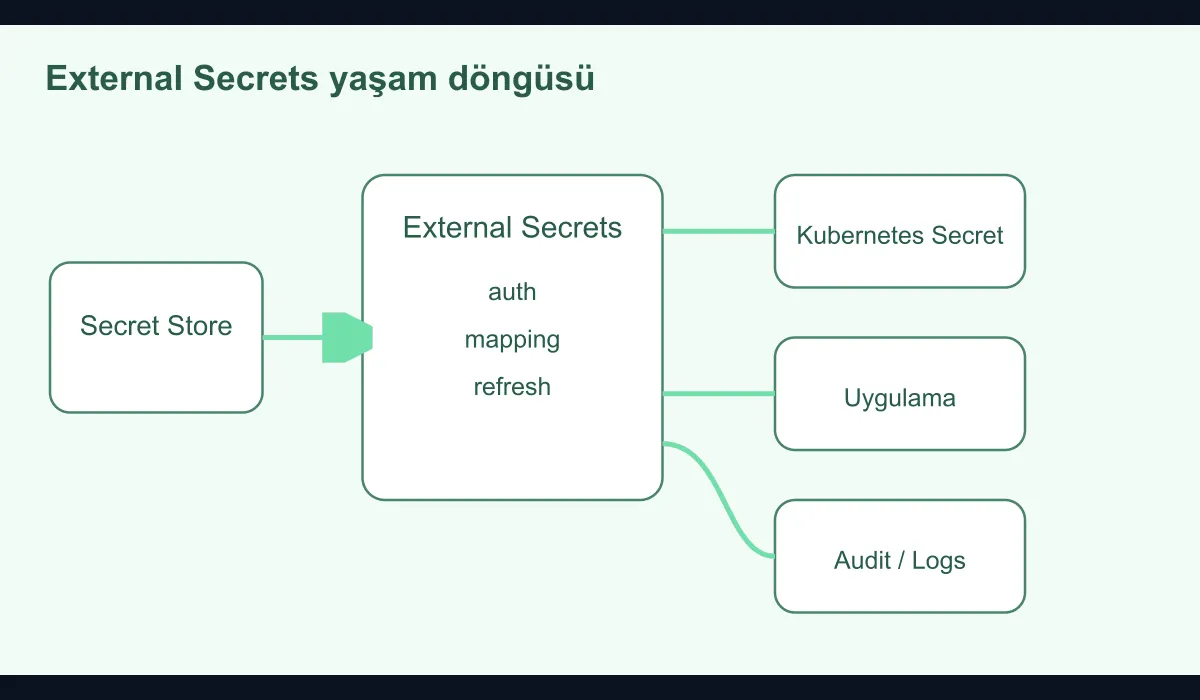
Why is External Secrets necessary?
Because the Kubernetes Secret object is a storage format; not a solution to the secret lifecycle. As the following needs grow, an external source becomes a must:
- Regular rotation
- Different values per environment
- Access control
- Audit records
- Separating the secret source from the application manifest
At that point, the External Secrets Operator or similar patterns start making sense.
How does the basic flow work?
The model is simple:
- The application team creates an
ExternalSecretdefinition inside the cluster. - The operator connects to the central secret vault with an authorized identity.
- The relevant value is synchronized into a Kubernetes
Secretobject. - When the secret changes, the application is reloaded or a rollout is triggered.
A key advantage of this model is that the application manifest carries a reference to the secret, not the secret itself.
apiVersion: external-secrets.io/v1beta1
kind: ExternalSecret
metadata:
  name: app-db-secret
spec:
  refreshInterval: 1h
  secretStoreRef:
    name: vault-prod
kind: ClusterSecretStoreWhich design decisions are critical?
For a successful setup, these areas must be clear:
- Which team can access which secret path?
- How is environment separation enforced?
- What drives the choice of refresh interval?
- What is the application reload mechanism?
- Where is audit data collected?
Without making these decisions, deploying the operator only automates the secret-copying job.
Conclusion
The External Secrets flow for Kubernetes secret rotation moves secret management from the manifest level up to the lifecycle level. With a central vault, controlled access, and regular synchronization, you build a safer platform model. Especially in enterprise structures with multiple environments, multiple teams, and strict audit requirements, this approach delivers significant operational simplicity.