
In enterprise environments, one of the most fragile points of incident management is the concentration of command practice in a few strong individuals. As systems grow, the alarm count, the number of impacted teams, and the business pressure rise; yet the response rhythm often still rests on the shoulders of the same two or three senior engineers. This structure looks efficient at first, but over time it produces both burnout and shrinks the organization’s crisis capacity.
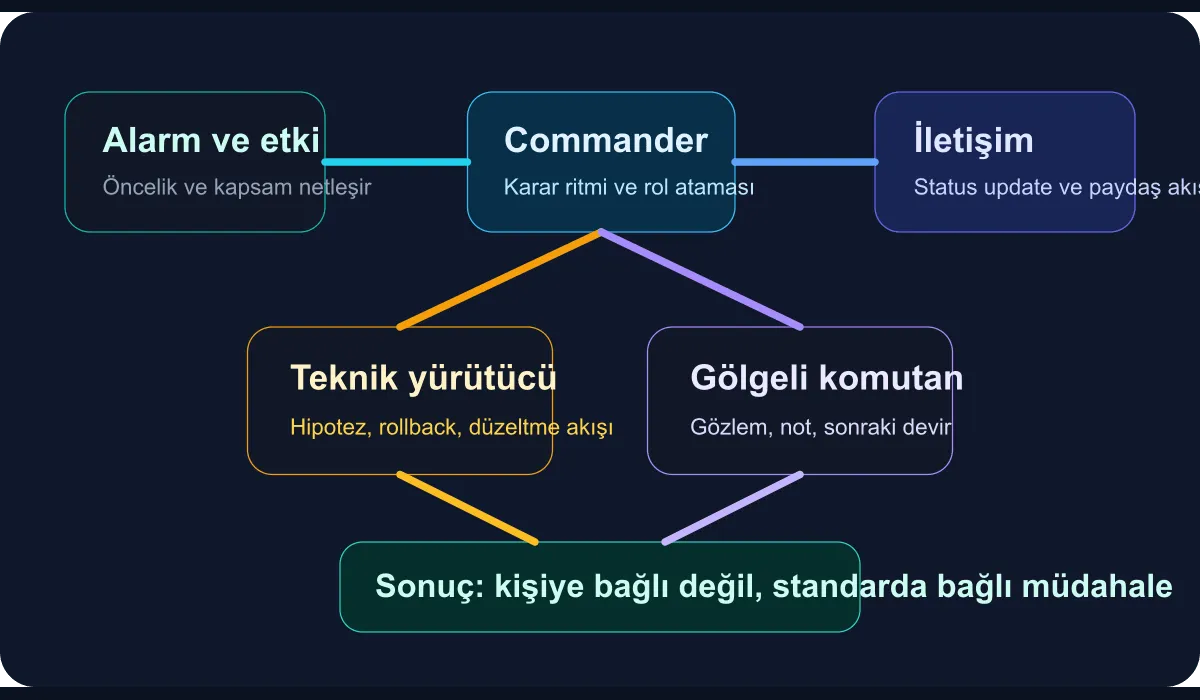
Why is command rotation needed?
If during an incident everyone tries to produce a technical solution simultaneously, visibility quickly breaks down. If it’s not clear who’s deciding, who’s running impact analysis, and who’s managing communication, teams start working in parallel but disconnected ways.
Command rotation solves three problems at once:
- Removes response leadership from a single person
- Produces a shared behavior standard among senior engineers
- Turns incident experience into a mentorship space
The goal here isn’t to hold more meetings. The goal is to design role clarity in advance to reduce uncertainty during the event.
Which roles are actually necessary?
Many teams define more roles than necessary. Yet for medium-sized enterprise structures, the following core setup is enough for most incidents:
- Incident commander
- Technical executor or solution owner
- Communication owner
- A note-taker if needed
Combining these roles into a single person is possible for small events; but in high-impact events, separating commander from executor makes a serious difference. The commander’s job isn’t to type the fastest command at the terminal; it’s to preserve decision rhythm and priority order.
What should rotation design be based on?
The rotation schedule isn’t just a calendar matter. Good design considers these inputs:
- The person’s contextual knowledge of that system area
- On-call and incident load over recent weeks
- Availability boundaries outside business hours
- Whether the next-level backup commander is ready
Especially in platform and infrastructure teams, the “whoever’s available, let them handle it” approach isn’t sustainable. Because, unlike technical expertise, the command role also requires coordination, decision clarity, and communication discipline.
How should the commander’s decision scope be bounded?
In enterprise structures, the most common error is assigning unlimited authority to the commander. Over time, this both creates excessive load and produces wrong incentives. A healthier approach is to clearly describe the commander’s authority boundaries:
- The decision to roll back or cut off traffic to contain impact
- The decision to call in additional experts
- Escalation to managers and stakeholders
- Communication frequency and update format
In contrast, things like permanent architectural changes, customer commitments, or high-risk data operations should be tied to a separate approval channel. This way the command role remains both strong and controlled.
How is rotation quality measured?
Just saying “we resolved the incident” isn’t enough. To understand whether the rotation is working, you need to look at these signals:
- How many minutes it took for the first situation summary to be shared
- Whether information was lost during commander handoffs
- The share of total incident hours owned by the same names
- The ratio of communication and role confusion in postmortem outputs
- How many events new commander candidates participated in as shadows
These indicators reveal whether command capacity has truly become institutionalized.
How should the mentorship dimension be designed?
Command rotation is a powerful tool for transferring senior engineering practice. For this, a shadow participation model is helpful:
- The new candidate first joins as an observer
- In the next event, they take on communication or note-taking
- Later, they take command in low-risk events
- The experienced commander provides only support and feedback
This approach transfers knowledge in real operational context rather than via slide decks. It also breaks the team’s belief that “only certain people can do this role.”
The most common design mistake
Many organizations define the rotation but skip the training. Yet command practice doesn’t form just by writing names. People need to speak a shared language:
- How will impact be summarized?
- How will the hypothesis be expressed?
- When will rollback be declared?
- In what situation will managers be brought in?
Without this framework, every new name on the rotation list brings a different standard, and trust erodes.
Conclusion
For senior engineers, designing incident command rotation isn’t a small addendum to the on-call calendar; it’s a foundational building block of operational resilience. Organizations stay standing not on the reflex of a few experts, but on a replicable decision discipline. When technical leadership can build this systematically, incident management becomes faster, calmer, and more instructive.