
I have watched many teams that run regular drills still scatter when a real incident hits. Most of the time the cause is not the lack of practice itself; it is that the practice has been reduced to its technical steps alone. When the alert fires, who speaks first, what counts as “enough visibility”, how the rollback sentence is phrased, and which language is carried up to leadership — none of this is rehearsed in advance. Under pressure, even excellent tooling stops being enough. For me as a technical leader, designing the drill narrative is what closes that gap.
Why is narrative design its own topic?
Because during an incident people start reading not just the system but each other. Two teams looking at the same metric can derive different priorities. One may put data consistency at the centre, while the other may push customer impact to the front. If that distinction has not been talked through before the drill, technical accuracy and communication rhythm begin to undermine each other once the incident starts.
Narrative design provides the shared frame here. When questions like “what is our first sentence in this kind of event, what counts as evidence at the second checkpoint, at what threshold do we treat rollback as the obvious option?” are answered ahead of time, teams stop merely following procedures; they start interpreting the same scenario in similar ways.
What does a drill narrative consist of?
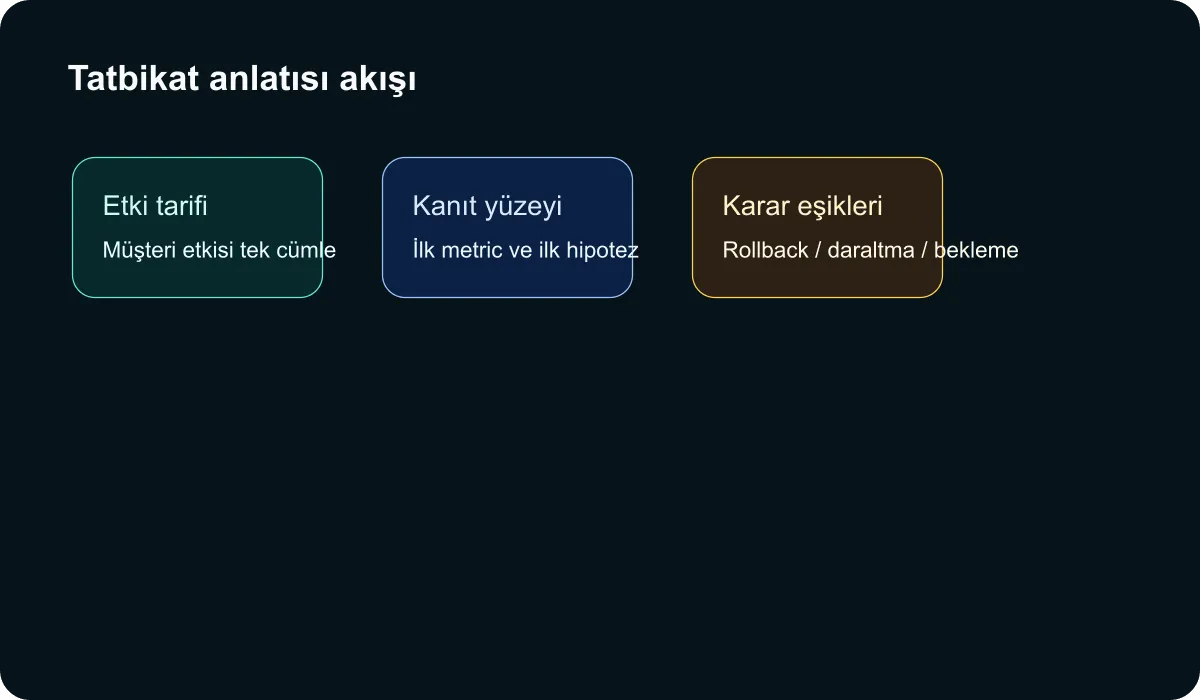
In practice, I find a five-part skeleton works very well:
- A one-sentence description of the impact
- The first hypothesis and the first surface of evidence
- The command, driver and communication roles
- The thresholds for rollback or impact reduction
- The decision expected at the next checkpoint
This structure lifts the drill out of the “let’s read a runbook together” mode. Teams rehearse in advance which decision is made with which information. Especially in enterprise settings, technical leadership is less about removing uncertainty entirely and more about making it carryable.
What language should the technical leader use?
When shaping the narrative beforehand, the leader’s language is decisive. “Does everyone know what they will do?” usually only earns a surface-level nod. Better questions are these:
- Which piece of information is one we cannot decide without in the first three minutes?
- Which sentence describes user impact most accurately?
- When the rollback decision lands, who defends it?
- In this scenario, what is the first question leadership will ask?
This kind of language pulls the drill out of being just an internal team simulation and turns it into corporate decision practice. People rehearse context, not only commands.
Which mistakes turn the drill into theatre?
The most common one is squeezing the drill down to tool validation. Just because the dashboard opened, the alert fired and someone ran the command, the drill is not automatically a success. If the team has not discussed at which moment communication is paused, at which moment a new hypothesis is no longer opened, and which evidence justifies the rollback, the same fog reappears in the actual incident.
The second mistake is making the narrative too scenario-specific. “If service X breaks, run command Y” style drills have a short shelf life. More durable value is built in the reusable layers — service impact, decision thresholds and communication rhythm.
Where does the mentorship dimension begin?
The drill narrative is a strong mentorship instrument for senior engineers. Junior engineers, before they ever face a real incident, see not only the technical steps but also the order of thinking. Why we shape the impact sentence first, why we do not open three hypotheses at once, why rollback is treated as risk management rather than weakness — these behaviours are learned exactly here.
That is why at the end of a drill it is worth asking not only “what will we fix” but also “which sentences worked, which decision point stayed blurry”. Technical leadership is often what becomes durable through this invisible transfer.
Conclusion
Designing pre-incident drill narratives for technical leaders takes incident readiness beyond a technical checklist. With a shared impact vocabulary, clear decision thresholds and a repeatable communication rhythm, the drill begins to change actual production behaviour. In enterprise teams, the strongest preparation is often not more tooling but the ability to tell the same story with similar clarity.