
In many organizations, the word escalation still carries a connotation of failure. When one team brings another team into the loop, the conversation usually drifts away from reducing technical risk and into the question of “why wasn’t this noticed earlier.” The natural outcome of this culture is that teams delay asking for help. For a technical leader, the real job is to decouple the escalation decision from individuals and turn it into a blameless working rule.
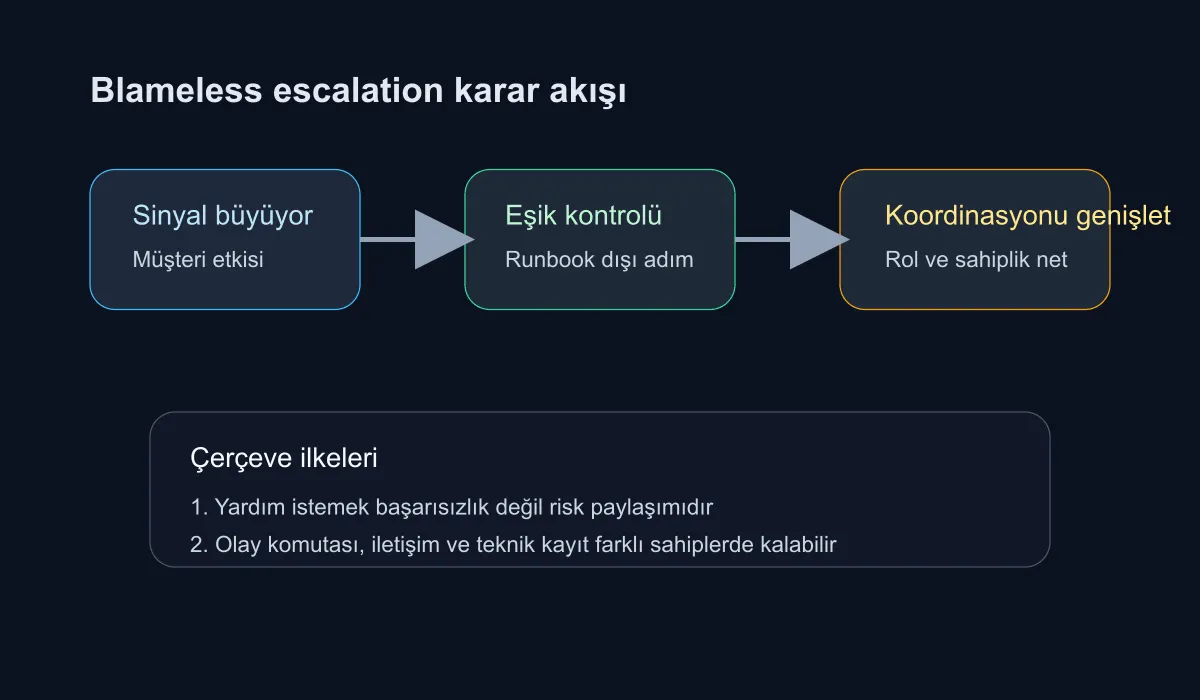
Why is blameless escalation a separate leadership topic?
Because the costliest delays in incident management usually come not from technical complexity but from social friction. A team sees the signal growing but waits too long to call in another team. The reason is usually not insufficient telemetry but the worry “if I call too early, will I create panic for nothing?”
A blameless framework reduces this ambiguity. The escalation decision rests on predefined thresholds rather than personal courage or seniority. That way the process manages risk-sharing discipline, not the psychology of asking for help.
Which thresholds should be defined up front?
In the field, I find it valuable to write four thresholds explicitly:
- Customer impact has started or is about to start
- A technical uncertainty has emerged that requires a step outside the runbook
- A dependency that cannot be resolved within a single team has surfaced
- Time to mitigate is starting to threaten the service objective
These items look simple, but when they are not written clearly, every team acts according to its own tolerance. As a result, two different reactions arise at the same risk level.
How is a non-blaming process built in practice?
The first rule is this: escalation is not the corporate equivalent of “we made a mistake.” A more accurate sentence is “the risk now requires broader coordination.” This linguistic shift sounds small but directly affects response speed.
The second rule is that the process is not invented at the moment of the meeting. Roles need to be set in advance:
- Who holds incident command?
- Which teams get pulled in, and in what order?
- Who keeps the technical decision log?
- Who produces the external communications summary?
Without this clarity, escalation stops being a mechanism that accelerates resolution and turns into a chaotic broadcast list.
Why is the technical leader’s language decisive?
Technical leaders don’t only make decisions during an incident; they also shape how the incident feels. The question “why didn’t you tell us earlier?” can poison the entire culture in a few seconds. Instead, these questions are healthier:
- Which signal crossed this threshold?
- Which dependency is slowing us down right now?
- Which expertise is missing, leading us to widen the scope?
This approach makes the system visible rather than the people. Especially for senior engineers, this language model also produces a mentoring effect; junior engineers see that asking for help is not a career risk.
Which records should be kept after escalation?
For the blameless culture to last, three records must always emerge after the process:
- Did the threshold fire in the right place, really?
- What would have changed if it had fired earlier?
- Which runbook, alert, or ownership gap created this need?
The aim here is not to prepare a defense but to improve the thresholds over time. Otherwise, teams replay the same debate during the next incident.
The most common anti-pattern in enterprise structures
Some organizations write the escalation matrix in extreme detail, but make it so heavy that no one will actually open and read it in real life. Others leave it entirely to intuition. Both extremes are problematic. A good model runs on a few clear thresholds and a few clear roles.
Another mistake is reserving escalation only for critical incidents. But if early coordination is not built for medium-severity recurring incidents, the same pattern will explode more expensively later. The technical leader’s job is not just to shout during a fire, but to lower the cost of arriving late to coordination.
Conclusion
A blameless escalation framework for technical leaders matures the communication layer of incident management. When thresholds are clear, roles are defined, and the language is non-blaming, teams ask for help earlier, make calmer decisions, and information flows in a more orderly way. At enterprise scale, real speed comes not from heroics but from safe processes that bring the right people in at the right moment.