
In most teams, the most critical issue is not missing documentation — it is that the knowledge explaining how the system actually behaves lives only inside a few people’s heads. Why an alert threshold was picked the way it was, which integration always misbehaves on Friday nights, which maintenance step is genuinely risky, which customer’s traffic triggers which side effect — most of this gets recorded in memory rather than in the ticket system. For a senior engineer, the tacit knowledge inventory cadence is the discipline of turning that invisible layer into something the team can read together.
Why does tacit knowledge turn into organizational risk?
At first glance, tacit knowledge looks like efficiency. The experienced engineer wraps up a problem fast, the meeting wraps up early. But that speed is usually borrowed against the organization. As long as knowledge stays in one head, team independence drops, on-call quality fluctuates, and service ownership — which appears distributed on paper — quietly narrows.
This risk grows especially when:
- Long-lived systems have been shaped by historical decisions
- The same handful of people keep getting paged for incidents
- Runbooks describe steps but not the reasoning behind decisions
- Team rotation or platform migration is accelerating
The problem is not just knowledge loss. Tacit knowledge also produces decision lag and a false sense of confidence. Documentation is assumed to exist while critical thresholds still travel through oral tradition.
What does taking inventory actually mean?
The goal is not to write everything down. The real work is identifying high-impact, low-visibility clusters of knowledge. I find it useful to break them into four buckets:
- Operational shortcut knowledge
- Historical decision context
- Fragile dependency observations
- Human and process-based handover rules
Take a concrete example: “this job sometimes times out” is not knowledge — it is an observation. The knowledge is: “the timeout only fires when the ERP-side reporting window opens, because IOPS pressure climbs on the same storage pool.” The value of the inventory shows up exactly in that gap.
Where should it be sourced from?
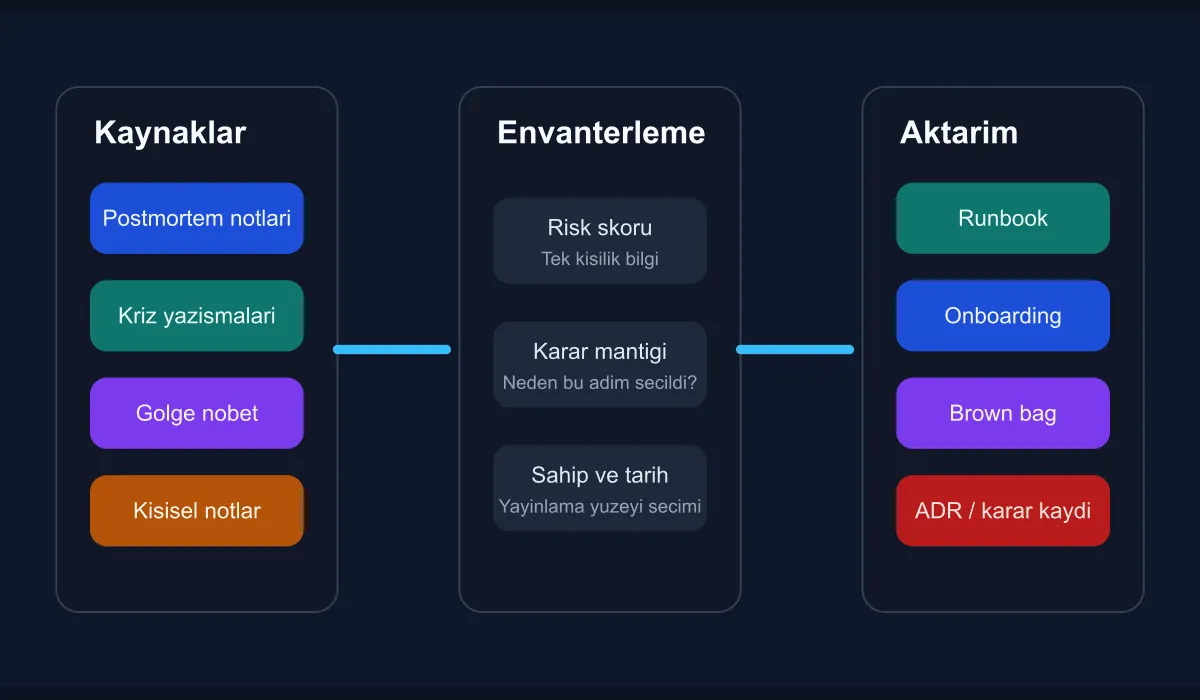
Tacit knowledge rarely lives in one document. You’ll catch it on these surfaces:
- Postmortem notes
- Slack or Teams crisis threads
- Ad-hoc checklists opened after a change
- Personal notes kept by senior engineers
- Sentences dropped during shadow on-call or onboarding sessions
These sources are scattered. So the inventory effort cannot be a one-time archiving project; it has to be a recurring cadence. A short, focused monthly sweep is more valuable than a single yearly knowledge clean-up.
How do you build a solid cadence?
In practice, I find a forty-five minute monthly session works well. The point of this session is not retrospective theater — it is to surface knowledge that has piled up inside a few people over the recent period. A simple flow is enough:
- List incidents in the last thirty days that only specific people resolved
- Identify the unwritten decision points inside those incidents
- Decide which piece of knowledge becomes a runbook entry, an architectural record, or an onboarding note
- Assign an owner and make the closing date visible
The point here is not to produce a “would be nice to have” list. The point is selecting items that will change team behavior. A good cadence does not separate gathering knowledge from publishing it.
Which knowledge should you tackle first?
Not every piece of tacit knowledge is equally valuable. These questions help you prioritize:
- Without this knowledge, would incident time stretch out?
- Is change risk going up because this knowledge sits with one person?
- Does this knowledge create friction in cross-team communication?
- Does this knowledge directly affect a new engineer’s ability to operate independently?
When you look through this lens, some shiny technical details slide to the back, while some seemingly mundane sentences turn critical. For example, which integration produces false negatives outside its real testing hours can matter more than which port a firewall rule opens.
How does the tacit knowledge inventory connect to mentorship?
Senior engineering is not just about solving the problem — it is about multiplying the team’s capacity to solve. That is why the tacit knowledge inventory ties directly into mentorship. Knowledge does not produce value when it is written down in isolation; it produces value when the team uses it.
So every inventory item needs a small delivery method attached:
- A runbook update
- A short demo or brown-bag session
- An on-call shadowing note
- An architectural decision record
- An onboarding step for new joiners
The place where knowledge is stored does not have to be the same surface where it is learned. But there has to be an intentional bridge between them.
The most common mistake: dumping everything into the wiki
A frequent failure mode in enterprise teams is trying to solve the tacit knowledge problem at the level of “let’s open a Confluence page.” That approach quickly produces a graveyard of documents. Knowledge does not get prioritized, owned, or anchored to the moment it gets used.
The better approach is to keep the inventory small and protect a few disciplines:
- Every entry must tie back to a risk or a decision moment
- Every entry must reference a system that has a current owner
- Every entry must require regular maintenance
- Every entry must connect to either a runbook, onboarding, or an architectural record
Without these filters, knowledge piles up but ambiguity does not shrink.
Conclusion
For senior engineers, the tacit knowledge inventory cadence is not a documentation campaign — it is an investment in team independence. When you pull system knowledge out of personal reflexes and onto the shared work surface, incident quality rises, service ownership becomes more real, and mentorship stops being an abstract good intention. Organizational maturity becomes visible exactly here: in owning not just the people who know, but an operating model that carries the knowledge.