
A lot of technical teams accept alert fatigue as a natural side effect of monitoring. In reality, the issue is usually not tooling — it is a leadership design problem. A noisy alert stream comes out of the combination of unclear service ownership, weak incident classification, missing feedback loops, and unmeasured on-call load. For a tech lead, the real job — before reducing alert count — is building an operating model that ties this signal stream to team learning.
Why is alert fatigue a cultural symptom?
Alert fatigue usually opens with one sentence: “Let’s just silence this one too.” Short term it feels like relief. Long term it makes system behavior more opaque. Because the real questions producing the noise stay on the table:
- Which alarm actually represents user impact?
- Which alarm is just repeating a technical symptom?
- Which alarm has a clear owner?
- Which alarm, when it closes, completes an actual learning loop?
Without answers, the problem is no longer just a threshold value. The problem is that observability signals are not wired into the operating model.
The right question: not how many alarms, but what changes after one
In comparable teams, the useful approach is this: do not make alarm volume the headline metric. Some periods, an increase in alarms is even healthy — a new service launches, a new error class becomes visible, a new SLO starts being tracked. What matters is what happens after the alarm.
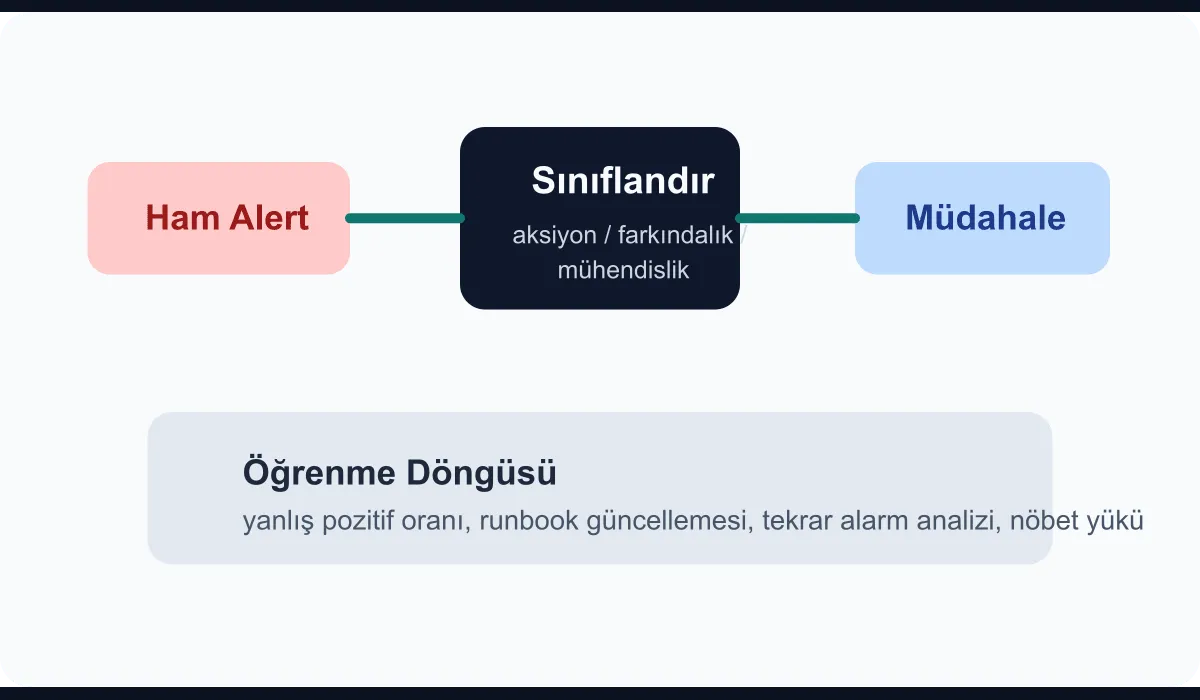
A good tech lead enforces this flow for every alarm class:
- Was the alarm seen?
- Did the right team engage?
- Was the impact level classified correctly?
- Was a permanent improvement ticket opened?
- When the same alarm fires again, does the team carry less cognitive load?
Without that flow, the alarm can close while the organization remains unchanged.
Split the alert portfolio into three buckets
If you apply the same governance to every alarm rule, the result is either heavy bureaucracy or uncontrolled growth. In practice, three buckets are enough:
- Action alarm: the on-call team is expected to respond within a defined window.
- Awareness alarm: no immediate response needed, but it feeds the team’s rhythm.
- Engineering alarm: signals a trend, quality, or capacity issue and belongs in the work plan.
This split unlocks an important kind of relief. You no longer have to turn every signal into a 2 AM page. And you do not make production behavior invisible either.
Measure on-call load by error class, not service
Most teams measure on-call load by pages-per-person. That is not enough. Two teams getting the same number of pages can drain at very different rates — because the context is weak, the resolution paths are scattered, or the same root cause keeps appearing through different alarms.
A more useful model is to classify alarms along these lines:
- Known with a runbook
- Known but with a manual action
- Unknown and requiring investigation
- False positive or low-value
Once that visibility exists, the tech lead sees more clearly which investment will actually reduce on-call load. Sometimes you do not need new tooling — merging two alarms, standardizing one field, or simplifying a decision tree is enough.
How do you run a learning loop?
Teams that reduce alert fatigue do not run an alarm review meeting; they build an alarm learning cadence. The distinction matters. Reviews tend to audit the past. A learning cadence reduces future cognitive load.
The framework I recommend looks like this:
- Every week, the top 10 most frequent alarms are inspected.
- For each alarm, user impact, response time, and reason for repetition are tagged.
- Permanent actions are split into three classes: remove, merge, strengthen.
- The following week, what actually changed is measured.
The aim here is not blame-finding. The aim is converting noise into organizational learning.
Which metrics should a tech lead watch?
Alarm count alone is misleading. A better dashboard:
- False-positive rate per action alarm
- Time from alarm to first meaningful action
- Repeat-alarm rate from the same root cause
- Percentage of alarms with an updated runbook
- Open actions carried per person after on-call handover
These metrics tell you not just whether the team is keeping operations alive, but whether operations are teaching the team anything.
Where does tension between product and platform teams show up?
Alert fatigue often grows because the platform team feels the noise while the product team feels the inefficacy. Platform side says, “we get too many pages”; product side replies, “but the issues are real.” Both can be right at the same time. The lead’s job is to translate that tension into a shared risk language.
For instance, a high-latency alarm can be split as follows:
- If there is customer impact, it is an action alarm
- If only an internal service queue is growing, it is an engineering alarm
- If it is expected fluctuation during deploy, it is an awareness alarm
The same signal can flow through different operational paths depending on context. What sets that up is the design quality of the technical leadership.
Conclusion
Alert fatigue may look like an observability tooling problem, but in practice it is a problem of the team’s learning economy. When the tech lead reorganizes the alarm portfolio along risk, action, and learning, both on-call health and incident quality lift. Real success is not a quieter system — it is a team layout that produces more meaningful signals and runs a little lighter after every event.