
After a tough release, a rollback, or a production scare you barely escaped, technical teams usually drift toward one of two extremes. Either they pretend nothing happened and snap back to the regular flow, or for a while they treat every change with excessive suspicion. Both extremes are expensive. For a tech lead, the post-change confidence refresh session is the practice of rebalancing the team’s delivery rhythm — not through panic or denial, but through visible signals.
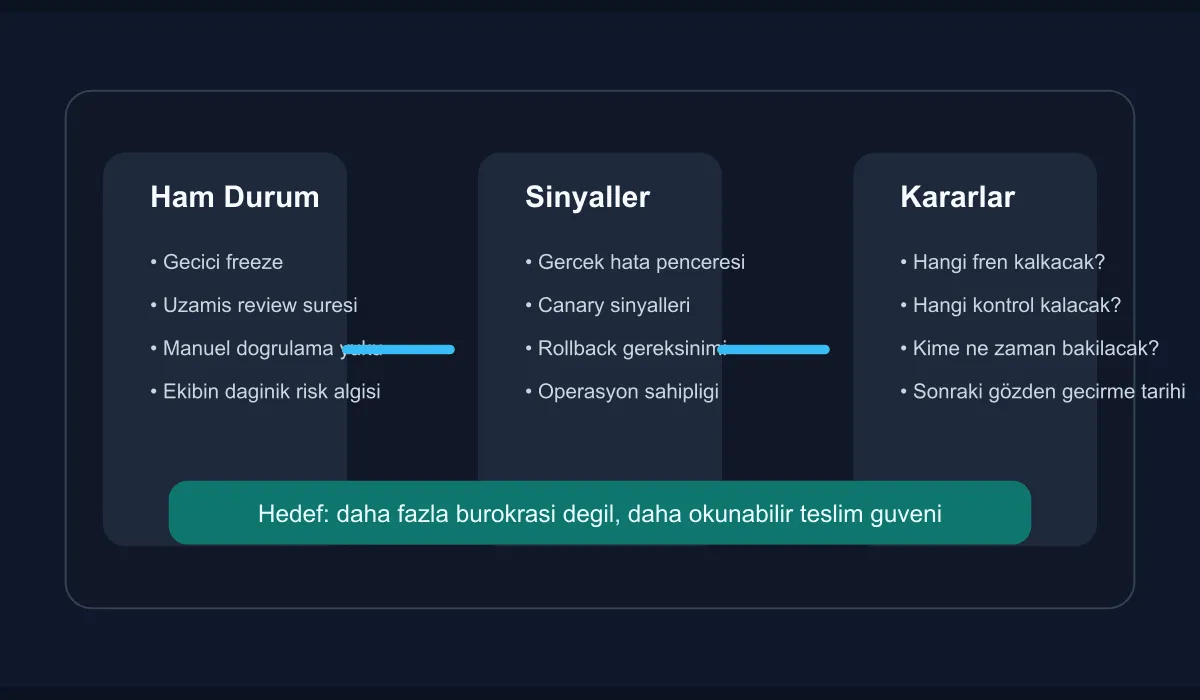
Why is confidence its own operational topic?
Because release confidence is not measured by passing tests alone. When a team experiences a string of problematic changes in a row, you start seeing these effects:
- Review cycles drag out unnecessarily
- Even small changes start feeling like high-risk moves
- The operations team requests more manual checks
- The product side stops trusting the technical team’s estimates
What gets lost here is not just speed. Decision clarity weakens too. The same change that looked acceptable a week ago can now turn into “let’s wait” purely because of today’s emotional context.
What does the confidence refresh session solve?
This session is not a retrospective and it is not a postmortem. The goal is not to assign blame or to relitigate every root cause. The goal is to separate the leftover uncertainty in the team into two piles after the recent change: which parts are real risk, and which parts are psychological echo.
I think it is right to expect three outputs from this session:
- Which deliveries can keep moving with confidence?
- Where do we need temporary confidence-boosting controls?
- Which of our existing rules are now producing more drag than value?
This frame uses data to narrow the team’s “let’s not touch anything for a while” reflex.
When should it happen?
Run it too early and everyone is still in defense mode. Run it too late and the emotional residue of the incident quietly settles into your operational decisions. In practice, the best window is the first or second business day after the incident or risky release closes. Technical detail is still fresh, but the team is no longer talking from raw reflex.
The session length matters too. Anything past forty-five minutes turns easily into a postmortem rerun. The aim here is a short, decision-producing conversation that has a real effect on the calendar.
What inputs should be on the table?
A good session runs on small but powerful data, not on intuition. I find these inputs are sufficient:
- The list of services or domains the change touched
- The actual error window observed after release
- Any temporary protective steps put in place
- Suggested control adjustments for the next similar release
- Where operational load has piled up
With these inputs, the meeting stops being an emotional assessment. Instead of “the team feels nervous,” you can move to readable sentences like “two people had to manually verify the same alarm.”
How do you keep the decision surface simple?
The tech lead’s main job here is breaking the discussion into small decision packets. I keep these categories separate:
- Temporary brakes that should be lifted now
- Confidence-boosting steps to add for the next release
- Structural gaps that need a permanent process change
Without that split, the team either over-tightens or forgets the lesson too fast. Especially for change-freeze decisions, you have to write an explicit exit condition. Otherwise, temporary brakes drift into culture.
The difference between confidence refresh and adding control
The easy-looking path to regaining release confidence is adding more manual approvals and longer checklists. But this approach usually does not produce confidence — it just formalizes the delay. The difference with a confidence refresh session is that before adding any control, you ask which control actually produces a signal.
For example:
- Will a new smoke test really catch a new error class?
- Does an extra approval reduce technical uncertainty, or just spread responsibility?
- Does extending the canary window improve decision quality, or only stretch the wait?
These questions make technical leadership visible. The lead’s job is not to agree to more brakes; it is to show where the right brake actually works.
Why team psychology should not be ignored
After a release accident, some engineers want more control, others want to snap back to normal immediately. Both reactions are understandable. But if the operating model does not handle that emotional gap, hidden tension forms inside the team. The confidence refresh session sets a shared language here: instead of personal comfort, an explicitly accepted team-level risk threshold.
That is why these sentences need to crystallize by the end of the session:
- This kind of change can move through the normal flow
- This kind of change requires extra telemetry
- This kind of change will go through temporary dual approval
- These rules will be revisited on this date
Putting an expiration date on a rule keeps temporary reactions from solidifying into permanent bureaucracy.
Conclusion
The post-change confidence refresh session is not a meeting to fix team morale — it is a tool to rebuild delivery confidence using engineering data. Done well, the team moves clearly, not fearlessly. The most valuable outcome is exactly this: keeping the capacity to make changes even after a risky release, without romanticizing the same mistake either.