
Teams adopting IaC move quickly in the early days with a single state file. But as the organization grows, different tenants, different environments, and different ownership boundaries start to feel cramped inside the same state. The result: a small change produces unnecessary lock contention, broad access permissions, and fragile plan output. With OpenTofu, the tenant-based state separation approach is not just a technical layout — it is a critical boundary definition for governance, security, and operational scale.
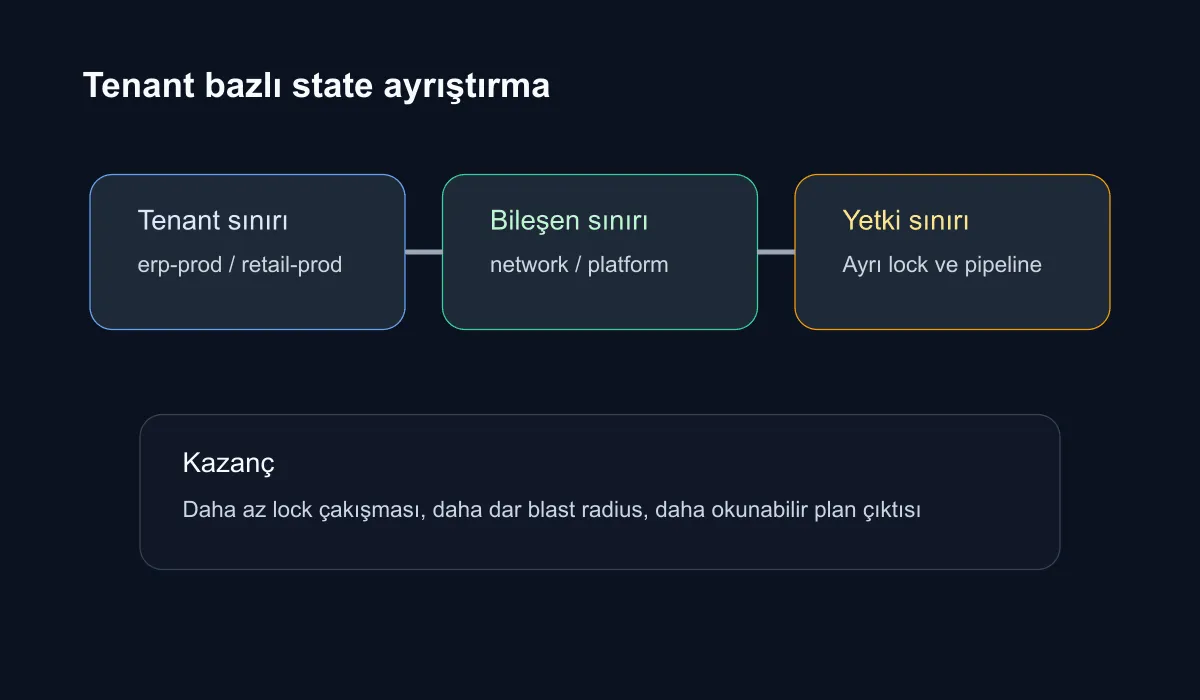
When should you leave the single-state model behind?
The following signals usually indicate the need for separation:
- Different teams keep getting stuck on the same plan lock
- Production and test environments live under the same state root
- A change in one tenant lists resources of another tenant
- Access permissions cannot be split at the state level
In these cases the problem is usually not the tool — it is the boundary model. The state structure has fallen behind the organizational structure and the security boundaries.
Reference folder layout
A clean, readable model can look like this:
infra/
  tenants/
    erp-prod/
      network/
      platform/
    erp-test/
      network/
      platform/
    retail-prod/
      network/
      observability/
The aim here is not to make every folder a separate state; it is to separate by change frequency, ownership, and impact area. Resources that do not share the same lifecycle should not live in a single state.
How should the backend definition be split?
On the OpenTofu side, the state key should be split by tenant and component. A simple S3-compatible backend example:
terraform {
  backend "s3" {
    bucket = "infra-state"
    key    = "tenants/erp-prod/network/tofu.tfstate"
    region = "eu-central-1"
    encrypt = true
    dynamodb_table = "infra-state-lock"
  }
}
What matters here is not just the key field; the lock and access policy must follow the same boundary. Otherwise the directory looks separated but the authority surface is not.
How do shared modules and tenant separation coexist?
Many teams fall into this trap: they assume that if modules are shared, state must be shared too. That is not correct. Using a shared module and using a shared state are different decisions.
The correct model is:
- The module code can be shared
- The variable set is tenant-specific
- The backend and lock area follow the tenant boundary
- The pipeline grant only reaches the relevant tenant state
Thanks to this separation the platform standard is preserved, but operational impact stays narrow.
What should the pipeline design watch for?
When the tenant-based structure is in place, the CI/CD pipeline must follow it too. I recommend the following rules:
- A separate plan job for each tenant-component pair
- Conditional execution for tenants with no changes
- Routing the plan output to the relevant owner team
- A separate approval and rollout step for production tenants
This model both produces parallelism and reduces unnecessary lock contention.
How should the migration be done?
Trying to split a large existing state in one day is risky. The safer method is gradual migration:
- First, the boundary matrix is drawn up
- The least dependent component is selected
- It is moved to its new root via
state mvor import strategy - The first few changes are observed to validate the lock and authority model
Particularly in production ERP or network layers, separation done without a dependency map produces new fragility.
Conclusion
Tenant-based state separation with OpenTofu is not just technical cleanup. It narrows the authority area, reduces plan lock contention, and makes the impact of a change readable. As enterprise infrastructure grows, real velocity comes not from one giant state but from small, clearly owned state areas operating inside the right boundaries.