
In many organizations, architectural decisions don’t really live in technical documents. They live in the heads of a handful of senior engineers. Why was that database picked, why did that service get moved into its own VPC, why was a particular alarm threshold accepted as good enough — the answers usually scatter across meetings and slowly evaporate. Then the team rotates, the system grows, and the same arguments come back round after round. Decision log discipline is what lets you move that institutional memory out of personal authority and into an operating practice the team can actually carry.
What does a decision log actually solve?
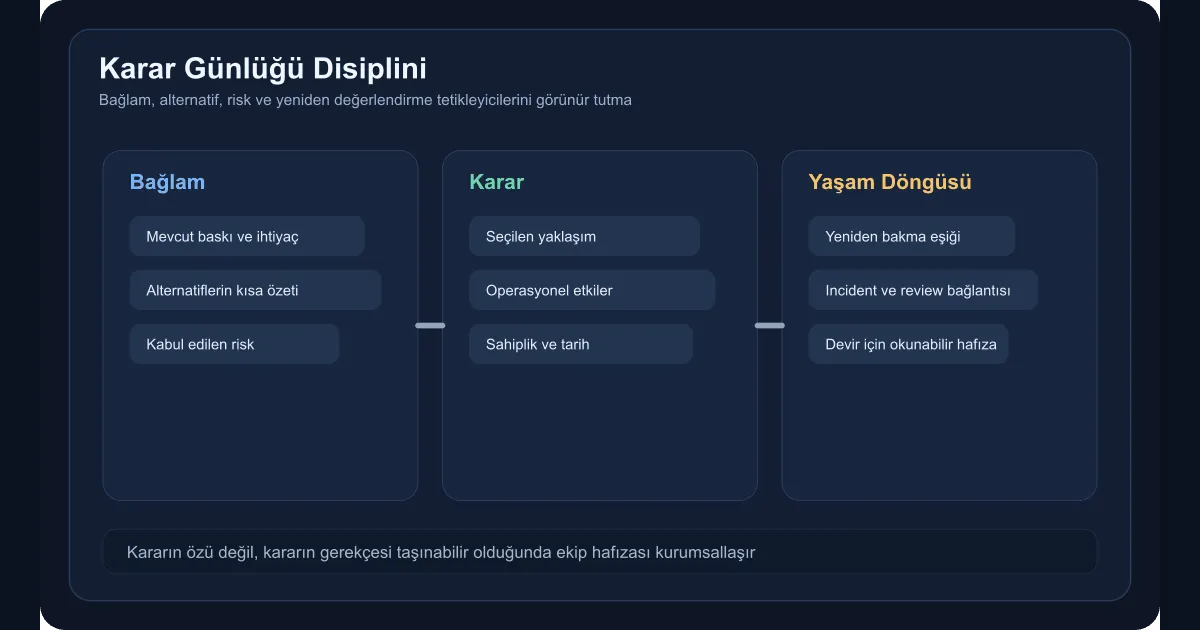
Writing a single ADR or a wiki page is not, on its own, a discipline. The real point is to make the lifecycle of critical decisions visible:
- What was the context for the decision?
- Which alternatives were ruled out?
- Which risk did we accept?
- Under what conditions should this be revisited?
When these questions stay unanswered, teams either treat past decisions as sacred or try to undo them without knowing why they existed. Both extremes are expensive.
Why is this specifically a senior engineering topic?
Because as you grow more senior, what’s expected of you shifts from a good solution to repeatable judgement. A junior engineer solves a problem. A senior engineer makes the reasoning behind that solution legible to the rest of the team. That’s why a decision log is more of a leadership practice than a documentation habit.
When it works well, the effects show up like this:
- Time-to-context for new joiners shrinks
- The same debates come back less often
- Decision boundaries become clearer during handovers and on-call shifts
- Postmortems and architecture reviews move faster
Which decisions belong in the log?
Not every small preference goes in. If the log gets bloated, nobody reads it. The ones I find genuinely worth recording look like this:
- Architectural choices that are expensive to undo
- Assumptions that shape security, networking, and access models
- Alarm, rollback, or release rules that change operational behaviour
- Data retention, replication, and backup strategies
- Temporary but critical workarounds accepted as exceptions
So a decision log isn’t a graveyard of every meeting note. It’s the record of the costly hinge points in your institutional memory.
What does a good entry look like?
I don’t find very long templates sustainable. In practice these fields cover most cases:
- Title: short name for the decision
- Date and ownership
- Context
- Alternatives
- Accepted risk
- Expected operational impact
- Trigger for revisiting
That last item matters more than people give it credit for. Many decisions get written down as if they’re true forever. In real infrastructure work, most of them are conditional on the environment. When traffic volume, team shape, or regulation changes, the right answer can flip.
Where’s the biggest operational payoff?
The value of a decision log isn’t visible only in architecture meetings. It shows up during incidents and changes. Mid-incident, the team should be able to answer something like: “Why did we go with reserved capacity on this service instead of aggressive autoscaling?” If that answer only lives in someone’s head, the risk balloons. If it lives in the log, response time drops.
The same is true for change management:
- Why is this network segment kept closed?
- Why does this service have a different rollout window?
- Why are some logs retained for so long?
Once these answers are in a place anyone can read, the team argues more calmly. The discussion moves from people to assumptions.
Why does this hit so hard for mentoring?
Senior engineering is, a lot of the time, the act of teaching invisible thinking. A decision log makes some of that invisibility visible. A new engineer reads not just the final architecture but the reasoning that produced it. That’s a serious shortcut for technical growth.
A pattern I find especially useful:
- Open a draft entry before any large decision
- Use the review to clarify alternatives together
- Add operational impact after the decision lands
- Drop a short evaluation note a few months later
This stops the document from being a static report and turns it into a living history of decisions.
The most common mistake
The first mistake is treating the log as something only the architecture team owns. Operational and platform decisions matter just as much. The second is wrapping the log in too much process. Once every entry needs a heavyweight approval, people stop writing them and the conversation just goes back to chat.
The right balance is: easy to open an entry, fast to read, clear how to update. The point of the discipline is to lower memory cost, not to manufacture bureaucracy.
Wrap-up
For senior engineers, a decision log is not a writing format — it’s an institutional thinking layer. Set up well, it makes architectural choices less dependent on individual authority, and it strengthens service handovers, incident response, and mentoring. As systems grow more complex, the most valuable thing isn’t just making the right call. It’s making sure the team can carry the reason for that call together.