
In enterprise infrastructure, one of the hardest problems is keeping management access both practical and auditable. On one side, operations teams need to connect quickly; on the other, the security side is rightfully uncomfortable with permanent VPN users, shared bastion accounts, and broad network visibility. The just-in-time access model eases this tension. WireGuard offers a strong foundation for this model; it provides a lightweight, open, and automation-friendly tunnel layer.
Why is the permanent VPN account a weak model?
The problem isn’t just that the account exists; it’s that the account becomes invisible over time. A user given management access months ago might have had a reason on day one. But these risks grow over time:
- The original business need that justified the access is forgotten.
- The same tunnel offers excessive visibility into many segments.
- A door stays open to the production management network outside of incidents.
- The audit log says “they had access” but can’t explain “why are they connected now.”
The just-in-time approach turns access from a default privilege into an explicit operational event.
Why does WireGuard fit well here?
WireGuard’s biggest advantage is that it isn’t complex. It’s not as heavy as IPsec, and it doesn’t require as many components as traditional remote access solutions. When designed well, it offers:
- Easy generation of short-lived keys and configurations.
- Access scope can be narrowed via paired IPs and route sets.
- Approval, opening, and closing can be wired into the same automation flow.
- The security boundary tightens without degrading the user experience.
The key point is not just to put WireGuard in place of a VPN. You need to make it a part of access orchestration.
How do I build the architecture?
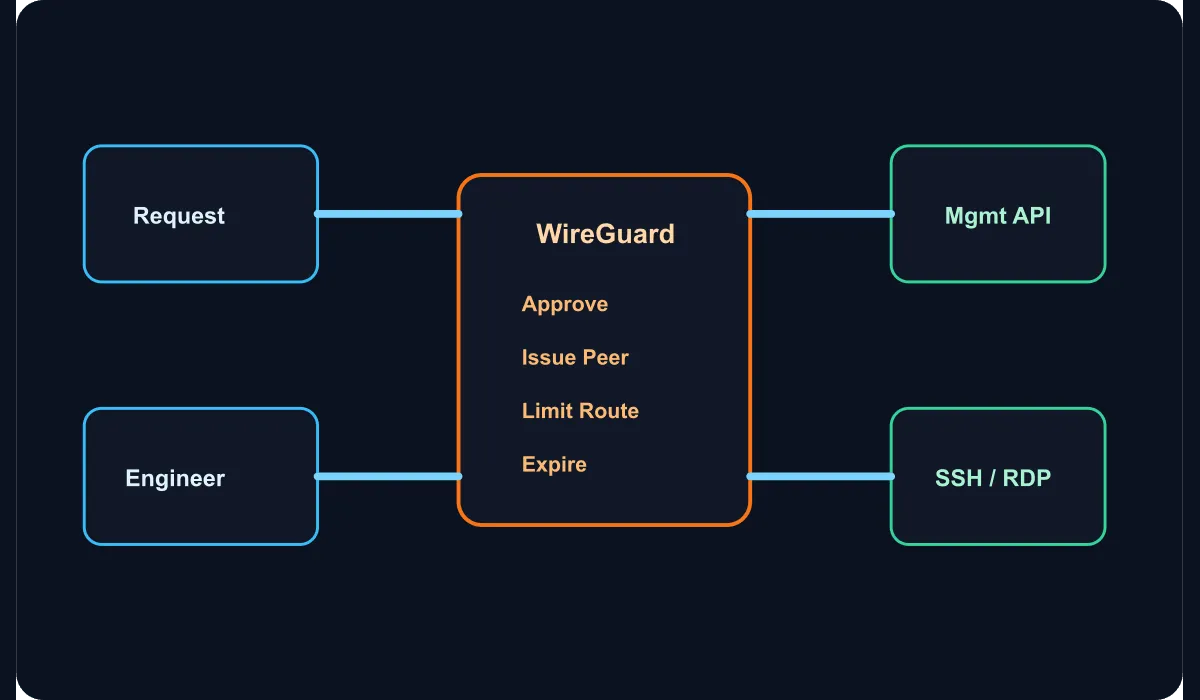
The model I recommend has four parts:
- Identity and approval layer
- Short-lived WireGuard peer generation
- Route set narrowed to the management network
- Automatic revocation after the session
In this model the user doesn’t carry a permanent peer. When needed, e.g., a 90-minute access window is defined, a peer file is generated, an audit trail is written, and access closes when the time runs out.
A simple configuration skeleton
The example below shows a clean WireGuard interface running on the management gateway:
[Interface]
Address = 10.90.0.1/24
ListenPort = 51820
PrivateKey = <gateway-private-key>
PostUp = nft add rule inet filter forward ip saddr 10.90.0.0/24 ip daddr 10.60.10.0/24 accept
PostDown = nft delete rule inet filter forward ip saddr 10.90.0.0/24 ip daddr 10.60.10.0/24 accept

[Peer]
PublicKey = <temporary-user-key>
AllowedIPs = 10.90.0.10/32
PersistentKeepalive = 25
In a real environment, this peer definition shouldn’t be written by hand. It should be generated by automation at the end of the approval flow and removed when time runs out.
Just opening a tunnel isn’t enough
A critical mistake here is making access short-lived but leaving routes wide open. For just-in-time access to work properly, these boundaries must be considered together:
- Which subnets can be reached?
- Which ports are open?
- Which jump host or management APIs can be accessed?
- During access, how is command history or session log correlated?
That’s why the WireGuard layer is usually addressed alongside firewall, PAM, SSH CA, or access logging systems.
Does the model break during an incident?
No, if it was designed beforehand, it actually works better. Because during an incident, not everyone needs permanent access. Instead:
- The on-call engineer or incident commander opens an access request.
- Time-bounded peers are generated for the relevant people.
- Access opens only to the relevant segments.
- After the incident closes, all peers are automatically revoked.
This approach is cleaner from both a speed and security standpoint.
Signals you should measure
To know whether the model works, don’t just look at the connection count. These measurements are more valuable:
- Average access duration
- Ratio of sessions auto-closed at expiry
- Ratio of access scoped to the target rather than the broad segment
- Number of exceptions requiring manual intervention
- Time to open access during an incident
These metrics show whether the access is genuinely just-in-time, or just a VPN with a new name.
Conclusion
Building just-in-time access to the management network with WireGuard is a bigger step than swapping VPN technology. It reduces permanent privilege, makes access intent visible, and turns the audit trail into part of the operational flow. If you want secure management access in enterprise infrastructure, the issue isn’t only about encrypting the tunnel; it’s about clearly defining when and why the access exists. WireGuard provides a clean and strong foundation for that goal.