
Publishing internal services across a corporate network in a secure and manageable way involves more operational decisions than it initially seems. Standing up a reverse proxy is not enough; the domain name, TLS certificate, routing rule, and access control should all be part of the same flow. Traefik is particularly useful in this space because it brings together dynamic discovery, TLS automation, and modern proxy behavior in a single place.
What problem are we solving?
In many organizations, internal service publishing tends to grow like this:
- First, a single NGINX configuration is written.
- Then, as new services are added, the file gets crowded.
- Certificate renewal becomes a separate process.
- It becomes hard to read which host points to which service.
With Traefik, this behavior becomes more declarative and automated.
Starting architecture
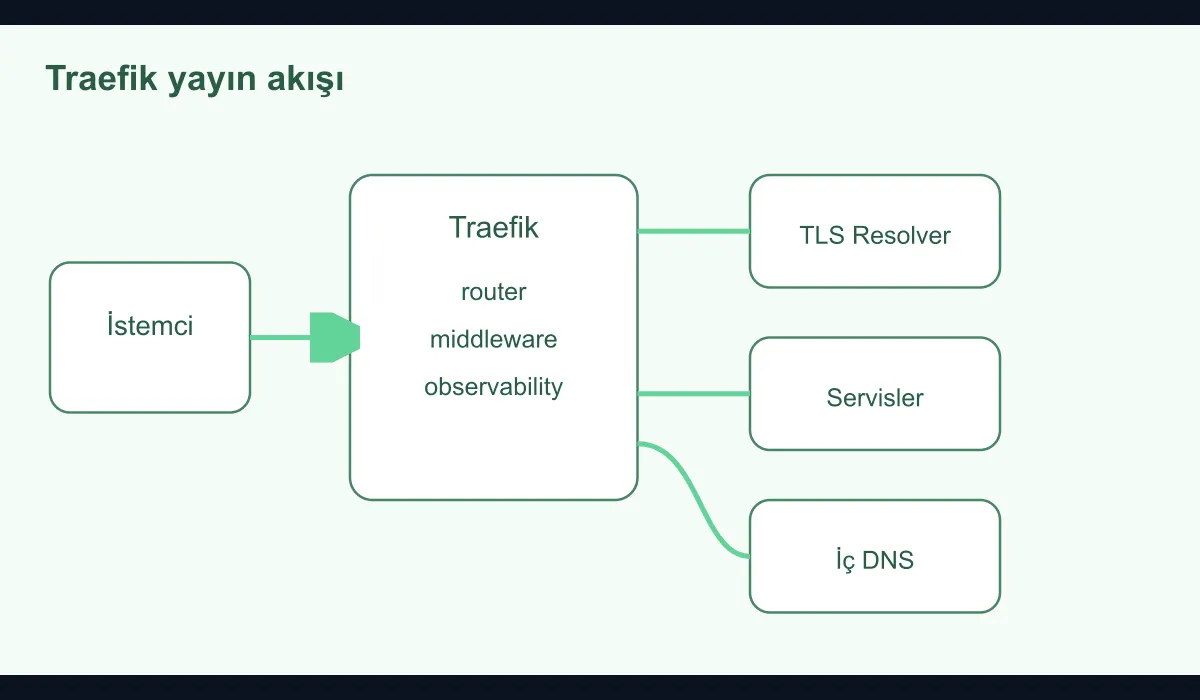
A minimum viable setup needs the following components:
- One or more
entrypoints - A dynamic service discovery source
- A TLS resolver
- Router, middleware, and service definitions
The value of this model becomes clear when you publish a new internal service without rewriting the entire proxy file.
entryPoints:
  websecure:
    address: ":443"

certificatesResolvers:
  internal:
    acme:
      email: [email protected]
      storage: /data/acme.json
tlsChallenge: trueWhich middlewares should be added on day one?
In practice, the following middleware set delivers the highest value:
- HTTP-to-HTTPS redirection
- Secure headers
- Simple IP or network access restrictions
- Request size limits
- Error page or maintenance-mode redirection
These matter even for internal services; while the corporate network is treated as trusted, it is not unrestricted.
What does operations gain?
The Traefik-based model makes life easier in several ways:
- Time to publish a new service is shorter.
- Certificate renewals become standardized.
- Routing errors are more visible.
- Docker, Kubernetes, or file-based discovery sources converge on a single model.
Conclusion
Publishing internal services and automating TLS with Traefik makes reverse proxy management more readable and sustainable. In enterprise environments, the real value lies not just in renewing certificates, but in publishing internal services securely, observably, and with low friction.